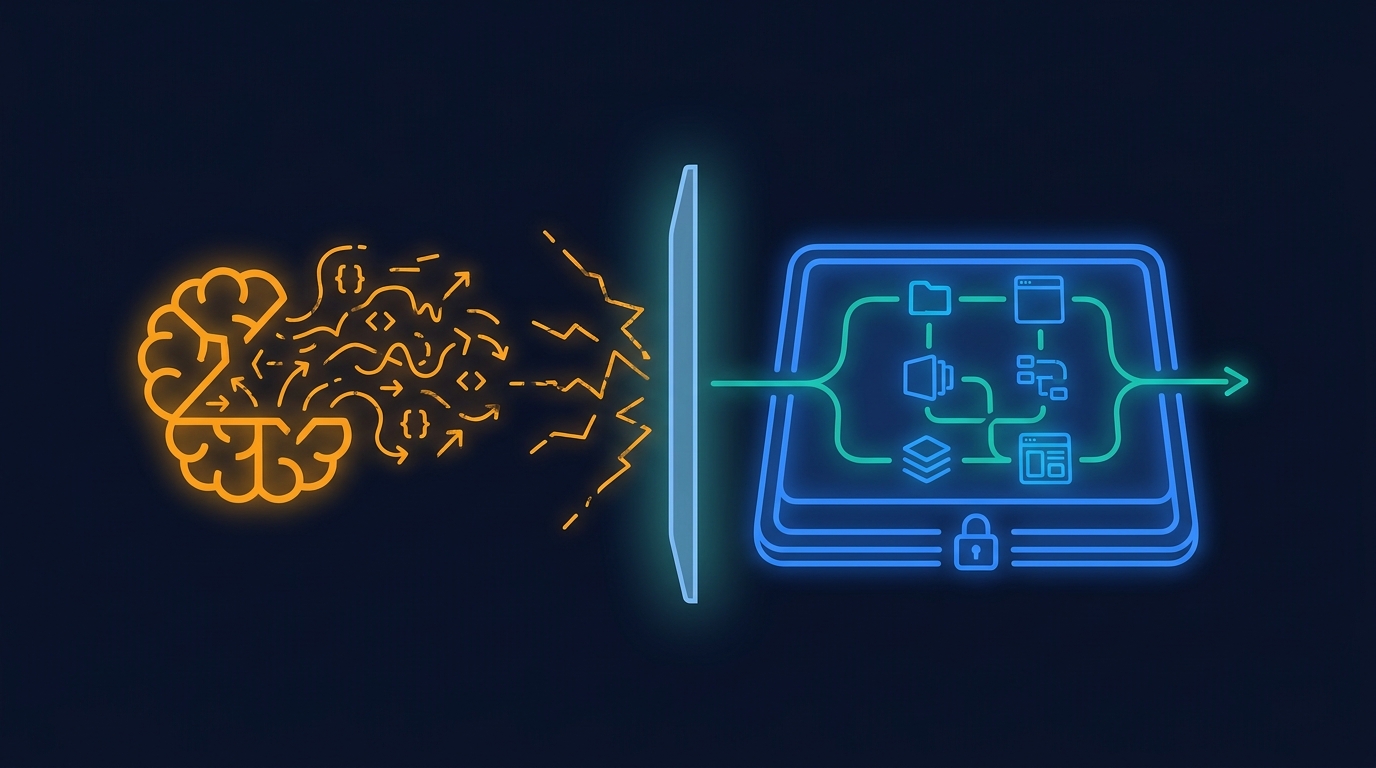
GPT-5.6 is another reminder that code generation keeps getting better. OpenAI says its new model beat prior frontier models on coding-agent benchmarks while using fewer tokens and less time.1 Stack Overflow's 2025 survey already showed 84% of developers using or planning to use AI tools.2
That still doesn't make a general coding agent the right interface for a SaaS customer.
The hard part inside enterprise software isn't producing code. It's letting a non-technical user build something useful without asking them to handle Git, deploys, environment variables, auth, permissions, tenant isolation, API docs, versioning, and support.
Key Takeaways
- AI coding is becoming default: Gartner predicts 90% enterprise engineer adoption by 2028.3
- SaaS customers don't need raw coding power. They need a governed builder inside the product.
- The winning pattern is constrained generation on top of existing APIs, permissions, and design systems.
Why Doesn't Better Code Generation Solve SaaS Customization? #
Better code generation solves part of the problem: Gartner says 63% of organizations were already piloting, deploying, or using AI code assistants in 2023.4 But SaaS customization fails after code exists. Somebody still has to host it, secure it, connect it to customer data, and make it feel native.
A prospect said this plainly on a call. He asked why his customers couldn't just use Claude Code or Cursor themselves. Then he answered his own objection while watching a demo: after the app is built, a business user still has to deploy it, share it, and make sure it can't delete or expose the wrong data.
That gap is why generic AI coding tools work so well for engineers and still fall apart for end customers. Engineers can recover from a failed build. A regional ops manager can't be expected to debug a broken auth callback before a board report.
[CALLOUT] A coding agent can produce a React component. A SaaS app builder has to know who the user is, which records they can see, what APIs are safe, which version is live, and how to roll back when something breaks.
What Do SaaS Customers Actually Need From AI? #
Stack Overflow found that 50.6% of professional developers use AI tools daily.2 The end customer inside a B2B SaaS product usually isn't in that group. They don't want a repo. They want a screen that answers, "Which invoices are over 45 days overdue?" or "Which technician needs help this week?"
On one sales call, a fintech SaaS founder described the customization problem as filter hell. One customer wants open invoices. Another wants overdue invoices. Another wants anything more than 30 days late. Another wants 45 days. The product team can keep adding toggles and dropdowns until the page becomes unusable.
The better interface is narrower. The user describes the workflow. The system uses the host product's APIs and design language. The output is an app, dashboard, form, or workflow that runs inside the product, not a loose script sitting next to it.
[PERSONAL EXPERIENCE] In one production deployment, users built more than 2,000 apps on top of a B2B SaaS platform. The important number wasn't the app count. It was 90% activation without training and 89% of users still active after 30 days. That only happens when the generated software stays inside the product people already use.
Why Do Boundaries Matter More Than Raw Model Capability? #
OpenAI's GPT-5.6 launch highlights stronger agentic coding, including multi-agent workflows and better tool use.1 That raises the ceiling, but enterprise SaaS adoption depends on the floor: the default behavior has to be safe enough when a non-engineer asks for something vague.
A good embedded AI app builder starts with constraints. It should know the approved API endpoints. It should inherit the host product's authentication. It should respect row-level permissions. It should compile and validate generated code before publishing. It should create versions and checkpoints so users can go back.
Those constraints don't make the AI weaker. They make it usable.
[CHART] Raw coding agents optimize for freedom. Embedded app builders optimize for safe usefulness: fewer possible actions, more context about the product, and much lower risk when the user is not technical.
What Should Enterprise SaaS Teams Build Instead? #
Gartner predicts at least 55% of software engineering teams will be actively building LLM-based features by 2027.3 The teams that win won't just add a chat box. They'll decide which jobs AI can safely perform inside their product boundary and give users a narrow path to production.
For SaaS customization, that means four rules:
- Use the product's existing APIs and permissions.
- Generate focused apps, not changes to the core product.
- Keep publishing, sharing, rollback, and audit logs built in.
- Treat customer-built apps as product signal, not just one-off support.
One lab software founder made this point better than any framework. If customers build their own apps inside your product, their effort becomes roadmap evidence. A feature request board tells you what people remembered to upvote. A customer-built app tells you what was painful enough to make them act.
[UNIQUE INSIGHT] That changes the product loop. Customization stops being a backlog of exceptions and becomes a live map of what customers actually need.
How Should Teams Evaluate an AI App Builder? #
Start with the boring checks. Gartner's 2025 software engineering trends warn teams to balance automation with human oversight, business criticality, risk, and workflow complexity.3 For an AI app builder, that means you should test governance before you test the demo magic.
Ask these questions:
- Can generated apps call only approved APIs?
- Do they inherit the current user's permissions automatically?
- Can admins review, version, publish, unpublish, and roll back apps?
- Does the builder understand your design system and data model?
- Can customers share apps with the right team without exposing data across tenants?
If the answer is no, you're not evaluating an app builder yet. You're evaluating a code generator with a better demo.
Want AI apps inside your SaaS product?
Gigacatalyst embeds a governed AI app builder into B2B SaaS products so customers can build workflows without leaving your platform.
FAQ #
Conclusion #
The next frontier in enterprise AI isn't whether models can write code. They can. The frontier is whether software companies can put that power inside the product boundary where customers already work.
For B2B SaaS, the best AI builder won't feel like a coding tool. It'll feel like the product finally learned how to adapt without making the core app worse.
Sources #
Footnotes #
-
OpenAI. "GPT-5.6: Frontier intelligence that scales with your ambition." https://openai.com/index/gpt-5-6/ 2026. ↩ ↩2
-
Stack Overflow. "AI | 2025 Stack Overflow Developer Survey." https://survey.stackoverflow.co/2025/ai 2025. ↩ ↩2
-
Gartner. "Gartner Identifies the Top Strategic Trends in Software Engineering for 2025 and Beyond." https://www.gartner.com/en/newsroom/press-releases/2025-07-01-gartner-identifies-the-top-strategic-trends-in-software-engineering-for-2025-and-beyond 2025. ↩ ↩2 ↩3
-
Gartner. "Gartner Says 75% of Enterprise Software Engineers Will Use AI Code Assistants by 2028." https://www.gartner.com/en/newsroom/press-releases/2024-04-11-gartner-says-75-percent-of-enterprise-software-engineers-will-use-ai-code-assistants-by-2028 2024. ↩