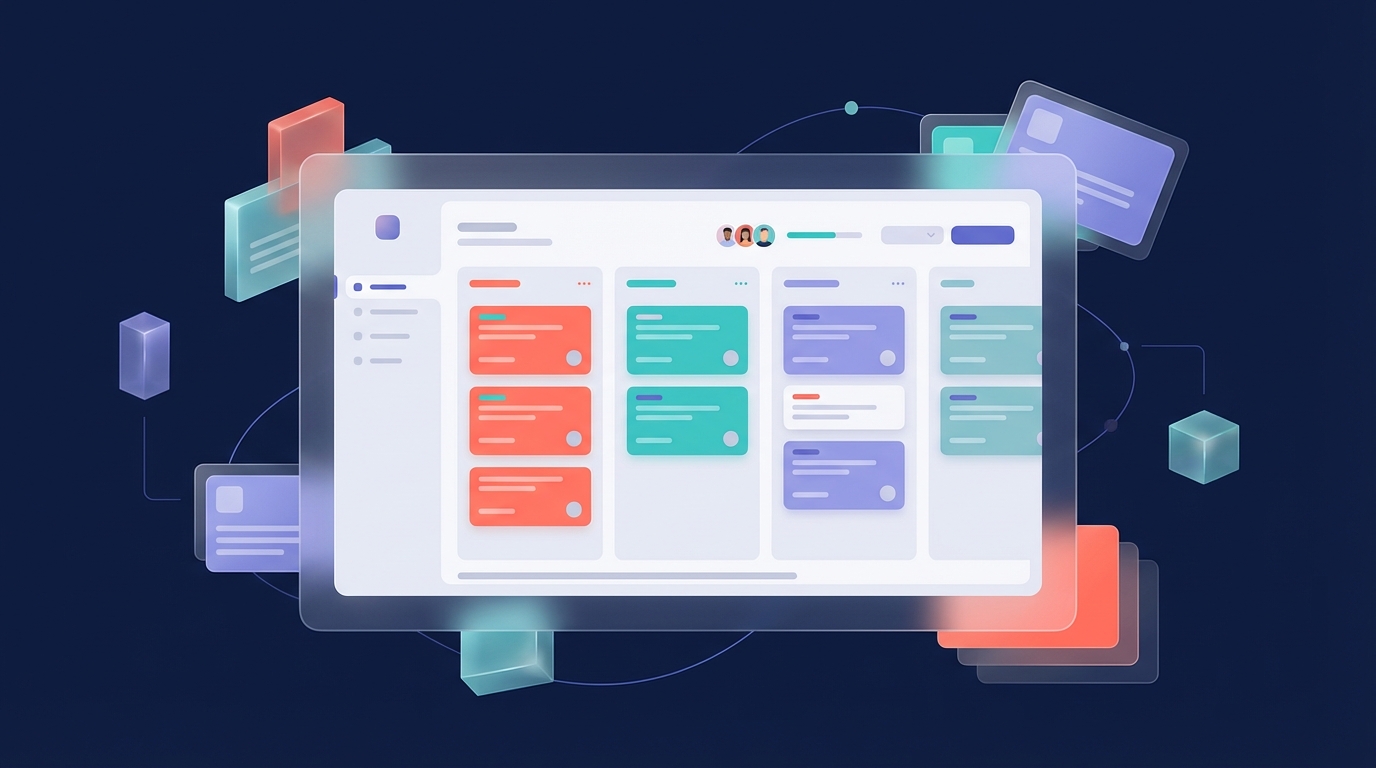
Monday.com crossed $1.2 billion in annual revenue in 2025, growing 27% year over year1. Their newest product, monday vibe, became the fastest feature in the company's history to hit $1 million ARR. The reason is simple: people want software that bends to how they work, not the other way around.
If you run a B2B SaaS company, you've probably had the same thought your customers have. "Why can't our product do what Monday.com does?" Your customers want visual dashboards, custom workflows, drag-and-drop boards, and apps that match their daily operations. Building all that from scratch would take your engineering team months, maybe years.
But what if you didn't have to build it from scratch?
Key Takeaways
- Monday.com's $1.2B revenue proves demand for customizable work tools is massive1
- Building project management features in-house costs $50K-$500K+ and months of engineering time2
- White-label AI app builders let you embed Monday.com-like functionality in weeks, not quarters
- One platform using this approach saw 90.8% user adoption and 89% day-30 retention
Why Do Your Customers Want a "Monday.com Experience"? #
Over 85% of businesses now use project management software, and the market is projected to reach $7 billion by 20263. Monday.com serves 225,000+ customers across 200+ industries because their product nails something most B2B SaaS products get wrong: it lets every team customize workflows without calling IT.
Your customers have seen this. They've used Monday.com, Notion, or Asana in their personal workflows. They expect that same flexibility inside your product.
The gap between what they expect and what your product delivers is where churn lives. Average B2B SaaS monthly churn sits at 3.5%4. And the primary driver isn't missing features. It's a mismatch between how the software works and how each customer needs it to work.
The real problem isn't features, it's fit #
A roofing company and a hospital both use the same CMMS platform. But one needs a lead prioritization dashboard and the other needs a compliance inspection workflow. One product can't serve both of them well with a single interface.
Monday.com solved this for work management by making everything customizable. Your challenge is different: you need that same customization layer inside your own product, connected to your own data, secured by your own permission model.
What Would It Actually Cost to Build This In-House? #
Custom SaaS development ranges from $50,000 to $500,000+ depending on complexity2. A project management module with boards, automations, dashboards, and custom views? You're looking at the upper end of that range, plus 6-12 months of engineering time.
And that's just the build. You'd also need to maintain it, update it, fix bugs, and handle every customer's unique requests. Your engineering team would be pulled away from your core product roadmap.
Here's what the in-house approach typically requires:
The engineering math #
Say you hire two senior engineers at $180K each to build a customization layer. That's $360K per year in salary alone, before benefits, tooling, and management overhead. In 12 months, you might ship a basic version. In 18 months, you might have something customers actually use.
Meanwhile, your product roadmap stalls. Features your existing customers are waiting for get delayed. And you've bet a year of engineering effort on a bet that might not pay off.
73% of B2B buyers say they want personalized, B2C-like experiences from their vendors5. The demand is real. The question is whether building it yourself is the right approach.
How Does Monday's "Vibe" Product Actually Work? #
Monday vibe is an AI-powered app builder that turns plain English prompts into fully custom business apps on the Monday.com platform. Users describe what they want: "Build me a time tracking dashboard for my marketing team." The AI generates a working app, connected to their Monday.com data, in minutes6.
No coding required. No engineering tickets. No waiting months for a feature request to get prioritized.
Sound familiar? This is exactly the model that's reshaping how SaaS companies think about customization. Instead of building every feature into the core product, you give users a way to build what they need themselves.
What monday vibe gets right #
It connects to real data (Monday.com boards). It respects existing permissions. It generates usable apps, not toy prototypes. Users can refine the output through conversation, iterating until the app fits their workflow.
What monday vibe doesn't do is work inside your product. It's built for Monday.com's ecosystem. Your customers can't use it to build apps on top of your APIs, your data model, your security layer.
That's the gap. And it's exactly the gap that white-label AI app builders fill.
What Is a White-Label AI App Builder? #
A white-label AI app builder is an embeddable platform that sits on top of your existing SaaS product. It connects to your APIs, inherits your security model, and lets your customers (or your CS team) build custom workflow apps using natural language.
Think of it as monday vibe, but for your product. Your brand, your data, your rules.
The architecture looks like this:
- Your customer describes a workflow in plain English
- The AI builder generates a working microapp connected to your real APIs
- Your security model is enforced on every data call, no new attack surface
- A built-in marketplace lets customers discover and share apps
This isn't a theoretical concept. Platforms like Gigacatalyst already do this in production. UpKeep, a YC-backed CMMS platform, embedded this approach and rebranded it as "UpKeep Studio." The results: 90.8% adoption rate and 89% day-30 retention across 946 users and 670+ microapps.
How to Add Monday.com-Like Functionality to Your SaaS #
Here's the practical playbook. Five steps, roughly two weeks from start to first customer app.
Step 1: Map your customization gaps #
Before building anything, audit where your product falls short for different customer segments. Interview your CS team. Pull your top 10 feature requests. Look at where customers build workarounds in spreadsheets or Zapier.
The patterns will cluster. Some customers need different dashboards. Some need workflows your product doesn't support. Some need data combined from multiple parts of your platform into one view.
These gaps are your starting point.
Step 2: Choose an embeddable platform #
You have three options:
Build from scratch ($50K-$500K+, 6-18 months). Full control, full cost, full risk. Only makes sense if customization is your core product, not a feature.
Use a horizontal tool (Retool, Appsmith). Better than building, but requires technical users, doesn't inherit your security model, and sits outside your product as a separate tool.
Embed a white-label AI app builder (Gigacatalyst). Fastest path. Inherits your APIs and security. Non-technical users can build apps. Comes with a marketplace. Takes weeks, not months.
Step 3: Connect your APIs and data model #
The embeddable platform needs to know your product. That means mapping your API endpoints, data schemas, and permission rules. A good platform handles API discovery automatically, reading your docs and sample data to understand what's available.
When we did this for UpKeep, the integration took about two weeks. The AI learned UpKeep's entire API surface, including which endpoints required which permissions, what data shapes to expect, and how to handle pagination.
Step 4: Seed the marketplace with first-party apps #
Don't launch with an empty marketplace. Build 5-10 apps that solve the most common workflow gaps you identified in Step 1. These become templates that show customers what's possible.
Good starter apps: a morning dashboard that surfaces the day's priorities, a calculator that combines data from multiple sources, a checklist workflow for multi-step processes, a reporting view that executives actually want to look at.
Your CS team can build these. No engineering required.
Step 5: Open the AI builder to customers #
Once the marketplace has traction, let customers build their own apps. Start with power users and expand. The AI builder means they describe what they need and get a working app, connected to real data, in minutes.
This is the flywheel. More apps get built. More problems get solved. Usage goes up. Churn goes down.
What Results Should You Expect? #
Software keeps only 39% of users after one month, on average7. That's a brutal baseline. The companies that beat it are the ones whose product genuinely fits each customer's workflow.
Here's what the embedded app builder approach delivered for one platform:
- 90.8% adoption rate: users opened at least one custom app
- 89% day-30 retention: users kept coming back because the apps matched their actual workflow
- 670+ microapps in production, built by both CS teams and end customers
- Zero engineering bandwidth consumed: CS teams shipped every custom solution themselves
The compound effect matters. Each customer that builds an app becomes more invested in your platform. Their workflows depend on it. Switching costs go up naturally, not through lock-in tricks, but because the product actually works for them.
What Are the Common Mistakes to Avoid? #
The most expensive mistake is trying to build the customization layer yourself when it's not your core competency. You'll spend $300K+ and 12+ months only to ship something that a specialized platform does better on day one.
Mistake 1: Treating customization as a feature, not a platform. Adding a dashboard builder or a form editor helps, but it doesn't solve the fundamental problem. Customers don't want one more feature. They want software that adapts to their workflow.
Mistake 2: Requiring technical users. If only developers or admins can customize the product, you've just moved the bottleneck. The whole point is letting non-technical users, CS teams, and customers themselves build what they need.
Mistake 3: Ignoring security inheritance. Any customization layer that introduces a separate auth system or new API permissions is a liability. The right approach inherits your existing security model so there's no new attack surface.
Mistake 4: Launching without content. An empty marketplace gets ignored. Seed it with high-quality first-party apps before opening it to customers.
Want Monday.com-like apps inside your SaaS?
Gigacatalyst embeds an AI app builder and marketplace directly into your product. Your customers build custom workflows in plain English. Your brand, your data, your security.
Footnotes #
-
monday.com Investor Relations. "Fourth Quarter and Fiscal Year 2025 Results." https://ir.monday.com/news-and-events/news-releases/news-details/2026/monday-com-Announces-Fourth-Quarter-and-Fiscal-Year-2025-Results/ 2026. ↩ ↩2
-
Innovecs. "How Much Does It Cost to Build a SaaS Platform?" https://innovecs.com/blog/how-much-does-it-cost-to-build-a-saas-platform/ 2025. ↩ ↩2
-
Gartner. "Software Market Insights: Project Management." https://www.gartner.com/en/digital-markets/insights/software-market-insights-project-management 2025. ↩
-
CustomerGauge. "Average Churn Rate by Industry: 2025 B2B Benchmarks." https://customergauge.com/blog/average-churn-rate-by-industry 2025. ↩
-
Accenture via McFadyen Digital. "The B2B Ecommerce Personalization Checklist for 2025." https://mcfadyen.com/articles/the-b2b-ecommerce-personalization-checklist-for-2025-keys-to-engaging-the-modern-buyer/ 2025. ↩
-
monday.com Support. "Get started with monday vibe." https://support.monday.com/hc/en-us/articles/28451758349842-Get-started-with-monday-vibe 2026. ↩
-
Pendo. "SaaS Churn and User Retention Rates: 2025 Global Benchmarks." https://www.pendo.io/pendo-blog/user-retention-rate-benchmarks/ 2025. ↩