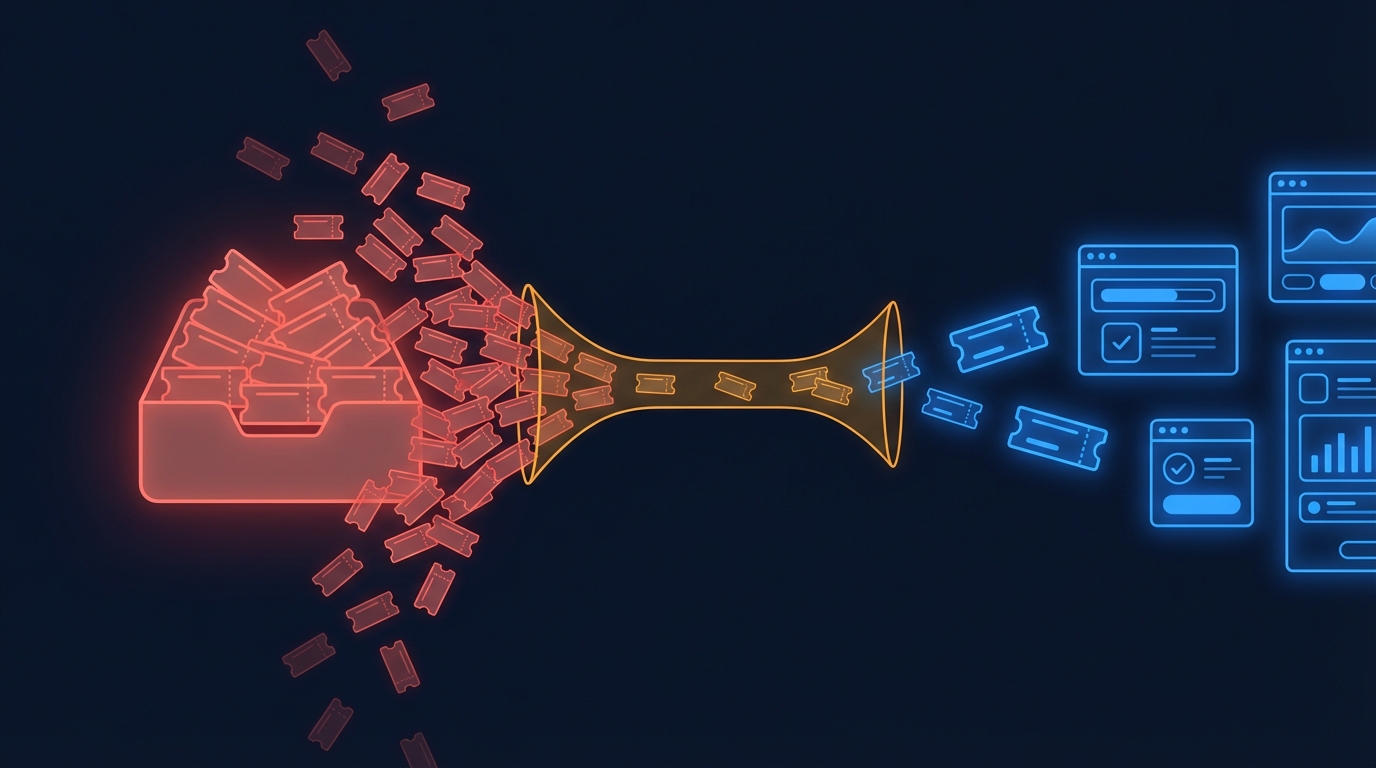
Why 70% of Enterprise Feature Requests Never Get Built (And What to Do About It) #
Your Feature Request Backlog Isn't a Prioritization Problem #
According to founders on Reddit's r/SaaS, the average B2B SaaS company rejects 70-80% of enterprise feature requests1. Not because product teams are lazy. Not because the requests are unreasonable. Because each request serves one customer's workflow, and the engineering team can only build for the majority.
This creates a structural gap between what your product does and what each customer actually needs. No prioritization framework fixes it. No amount of roadmap transparency makes it go away. The requests keep coming, the backlog keeps growing, and customers keep churning because the tool doesn't quite fit.
This article breaks down why the rejection rate is structural, what it costs you, and what the actual fix looks like.
Key Takeaways
- B2B SaaS companies reject 70-80% of enterprise feature requests. This is structural, not a management failure.
- Rejected requests create workflow mismatches that drive low adoption and eventual churn. B2B SaaS churn averages 4.9% annually2.
- The three common fixes (more features, config panels, custom engineering) all break at scale.
- A customization layer that sits on top of your product lets customers or CS teams build what they need without touching engineering.
- One production deployment achieved 90.8% adoption and 89% day-30 retention using this approach3.
Why Do 70-80% of Feature Requests Get Rejected? #
Reddit r/SaaS founder discussions consistently report that only 20-30% of enterprise feature requests make it to production1. The rest sit in backlogs until they're quietly archived. This isn't unique to small companies. It happens at every scale.
The math doesn't work #
Say you have 100 enterprise customers. Each submits 3 feature requests per quarter. That's 300 requests. Your engineering team can realistically ship 20-30 features per quarter. Even if every shipped feature satisfies multiple customers, you're still leaving 200+ requests untouched.
The problem compounds. Each quarter adds another 300 requests. The backlog grows faster than engineering can drain it. And the requests aren't generic. They're specific: "I need a view that shows overdue work orders filtered by site and sorted by technician availability." That's a real workflow need that doesn't map to any standard feature.
Niche doesn't mean unimportant #
Product teams often label these requests as "too niche." But niche to your roadmap doesn't mean niche to the customer. For the maintenance director who needs that specific view, it's the difference between using your platform for their actual job and exporting data to a spreadsheet every morning.
When the workaround becomes the workflow, your product is already losing. The customer is technically "active" but functionally checked out.
What Happens When Feature Requests Go Unbuilt? #
63% of organizations say unused or underutilized SaaS drives their consolidation decisions4. The path from rejected feature request to churned account follows a predictable sequence, and it rarely shows up in your analytics until it's too late.
The workflow mismatch spiral #
A customer requests a feature. You decline or deprioritize it. The customer builds a workaround, usually a spreadsheet, a Notion doc, or a third-party tool. Usage of your platform drops because the critical workflow now lives somewhere else. When renewal comes up, the CFO asks: "Why are we paying for a tool our team barely uses?"
B2B SaaS churn averages 4.9% annually2. That number looks manageable until you realize it's disproportionately concentrated among customers whose workflows don't fit your product. These are often your highest-potential accounts, the ones with complex operations and real willingness to pay.
Shadow IT fills the gap #
Gartner estimates that 30-40% of enterprise IT spend goes to shadow IT5. That's not rogue behavior. It's rational. When the official tool doesn't support the workflow, people find tools that do. Every shadow IT solution is a feature request your product couldn't absorb.
The risk goes beyond churn. Shadow IT fragments data, creates security gaps, and makes your platform less sticky. The more workarounds a customer builds outside your product, the easier it becomes to leave entirely.
Why Don't the Usual Fixes Work? #
92% of SaaS companies plan to increase AI integration in 20266. But before looking at new approaches, it's worth understanding why the three traditional responses to feature request overload all hit the same wall.
Fix 1: Build more features (the bloat trap) #
The instinct is to just build faster. Ship more features, hire more engineers, expand the roadmap. The problem: each new feature adds complexity for every customer, not just the one who requested it. Config surfaces grow. Onboarding gets harder. The product becomes a Swiss Army knife that nobody can find the right blade on.
Worse, the 70-80% rejection rate doesn't improve. More engineers means more throughput, but the ratio of niche-to-general requests stays the same. You're running faster on the same treadmill.
Fix 2: Configuration panels (the blast radius problem) #
Some teams try to solve this with flexible configuration. Let customers toggle features, set up custom fields, build their own dashboards. This works for simple preferences but breaks for real workflow customization.
Config panels have blast radius. Every option you expose is an option that can be misconfigured. Every custom field is a field that needs to work with reporting, permissions, integrations, and every future feature. The maintenance cost of deep configurability grows exponentially with the number of options.
Fix 3: Custom engineering for key accounts (the scaling wall) #
Enterprise teams sometimes assign engineers to build bespoke solutions for their largest accounts. This works when you have 5 key accounts. It breaks at 50. And it creates a two-tier experience where smaller customers get the standard product while big accounts get white-glove treatment.
The economics don't hold. A single custom integration can take 2-4 engineering weeks. Multiply that across dozens of enterprise requests per quarter and you've consumed your entire engineering capacity on one-off builds that don't benefit any other customer.
What Does a Structural Fix Actually Look Like? #
The pattern that's emerging in 2026 isn't about better prioritization or faster engineering. It's about changing the architecture so customers can solve their own workflow problems without touching the product codebase.
A customization layer, not more core features #
The fix is a layer that sits on top of your existing product. It connects to your data, respects your permissions model, and lets customers (or their CS teams) build workflow-specific apps without writing code. The core product stays clean. The customization happens in a sandboxed environment that can't break anything.
This is different from a plugin marketplace or an API. Marketplaces require developers. APIs require integration work. A customization layer lets a customer success manager describe a workflow in plain English and get a working app connected to real customer data, same day.
What this looks like in practice #
A maintenance director at a facilities company needs to see overdue work orders by site, filtered by priority, with one-click assignment to available technicians. In the traditional model, that's a feature request that sits in the backlog for 6 months.
With a customization layer, the CS team (or the customer themselves) describes the workflow. The system generates a working app that pulls from the existing work order data, respects role-based permissions, and runs inside the platform. No engineering ticket. No sprint planning. No 6-month wait.
The customer gets what they need. Engineering stays focused on the core product. The request never enters the backlog.
Does This Actually Work in Production? #
Gigacatalyst, a YC-backed white-label AI app builder, powers this pattern in production for a B2B SaaS platform serving maintenance and facilities teams3. The results tell a clear story.
The numbers #
- 90.8% adoption rate among users exposed to the customization layer3
- 89% day-30 retention, meaning users who built or used a custom app were still active a month later3
- 670+ microapps built by customers and CS teams in the first deployment period3
For context on why those numbers matter: B2B SaaS products typically see 30-50% feature adoption rates for new releases. 90.8% adoption suggests that the demand for workflow-specific solutions was already there. The product just needed a way to absorb it.
What got built #
The apps weren't complex. They were specific. A technician shift handoff checklist. A compliance inspection workflow. A spare parts lookup tool. Each one solved a problem that was real enough to file a feature request about, but too niche for the core product roadmap.
670+ microapps means 670+ feature requests that never entered the engineering backlog. That's not a marginal improvement. That's a structural change in how product demand gets absorbed.
If you're exploring how AI-powered customization fits into a B2B SaaS product, this deployment is worth studying as a reference implementation.
How Should You Think About This for Your Product? #
The question isn't whether your customers have unmet workflow needs. They do. The question is whether you absorb that demand inside your platform or let it leak into shadow IT and spreadsheets.
Start with the data you already have #
Pull your feature request backlog from the last 12 months. Categorize each request: is it a core product improvement (benefits many customers) or a workflow-specific need (benefits one customer or one segment)? If 60-70% of requests fall into the second category, you have a structural problem that engineering throughput alone won't solve.
Map the churn correlation #
Cross-reference your churned accounts with their feature request history. How many of them had open, unresolved requests at the time they cancelled? If the correlation is strong, you have a direct line from rejected requests to lost revenue.
Evaluate the customization layer approach #
A customization layer built on vibe coding principles isn't a replacement for your product roadmap. It's a pressure valve. Engineering focuses on the 25% of requests that improve the core product. The customization layer handles the 75% that are too specific for the general release.
The result: customers get what they need, engineering stays focused, and your platform becomes stickier because the custom workflows live inside your product, not in a competitor's spreadsheet.
See Gigacatalyst in Action
We build the AI platform layer that sits on top of B2B SaaS products and lets customers create their own workflow apps. Connected to real data. Governed by your security model.
Footnotes #
-
Reddit r/SaaS founder discussions on enterprise feature request rejection rates, 2024-2025. Multiple threads report 70-80% rejection as typical for B2B SaaS. ↩ ↩2
-
Vena Solutions. "B2B SaaS Churn Benchmarks." Reports average annual churn of 4.9% for B2B SaaS companies. ↩ ↩2
-
Gigacatalyst first-party deployment data. 90.8% adoption rate, 89% day-30 retention, 670+ microapps built during initial deployment period. ↩ ↩2 ↩3 ↩4 ↩5
-
BetterCloud. "State of SaaSOps 2025." 63% of organizations cite unused or underutilized SaaS as a driver of consolidation decisions. ↩
-
Gartner. "Shadow IT Spending Estimates." Estimates 30-40% of enterprise IT spend goes to shadow IT solutions. ↩
-
BetterCloud. "State of SaaSOps 2025." 92% of SaaS companies plan to increase AI integration. ↩