How to Add AI to Your B2B SaaS Product: A Step-by-Step Guide #
Most SaaS Companies Add AI Wrong #
92% of SaaS companies plan to increase AI integration in their products1. Yet only 7% of total SaaS applications are actually AI-enabled today1. The gap between intent and execution is enormous. Most teams ship a chatbot, add autocomplete to a search bar, and call it done. Then they wonder why churn doesn't improve.
The problem isn't whether to add AI. It's what kind. There are three distinct levels of AI you can integrate into a B2B SaaS product, each with different architecture, different investment, and dramatically different impact on retention. Most guides tell you to bolt on a chatbot. This one walks through all three levels so you can decide where to invest.
Key Takeaways
- 60% of enterprise SaaS products have embedded AI features, but most stop at surface-level extraction (autocomplete, classification, form pre-fill)1. That's Level 1.
- Level 2 (conversational AI with tool use) requires streaming, memory, and multi-step reasoning. 62% of organizations are experimenting with AI agents, but only 23% have scaled them2.
- Level 3 (customer-facing app generation) produces the highest retention lift. One production deployment achieved 90.8% adoption and 89% day-30 retention.
- You don't have to build Level 3 from scratch. Embeddable AI platforms can integrate in two weeks.
What Are the Three Levels of AI in SaaS? #
88% of organizations now use AI regularly in at least one business function, according to McKinsey's 2025 Global Survey2. But "using AI" can mean anything from a single API call that classifies a support ticket to a full AI runtime that generates custom applications per customer. The difference in business impact between these approaches is massive.
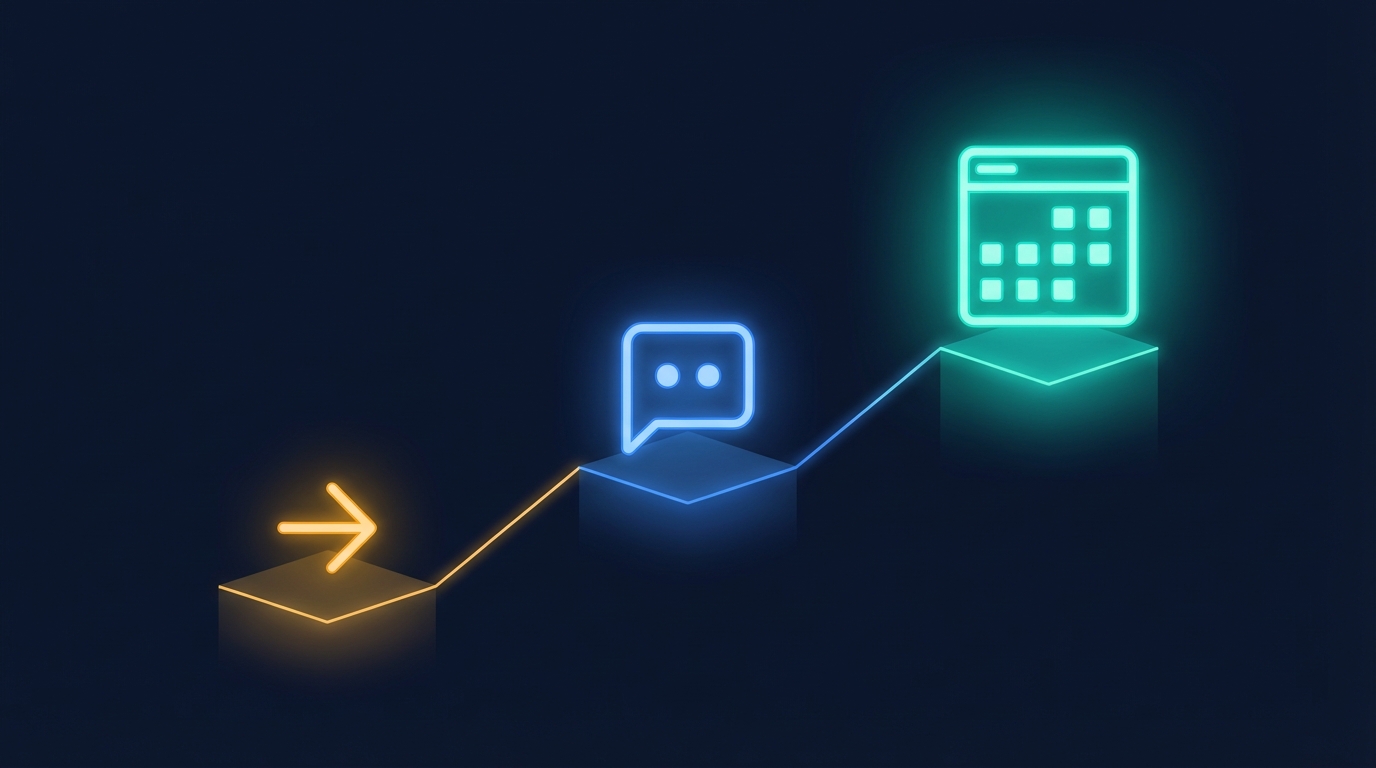
Think of it as three levels:
Level 1: Extraction. Single-shot AI calls. A user submits input, the model returns structured output. Photo-to-work-order, form pre-fill, text classification. Stateless, no memory, no conversation.
Level 2: Conversation. Chat-based AI with tool use, streaming, and memory. The AI can read and write data across your product, propose multi-step plans, and hold context across a session. Think Salesforce Einstein or HubSpot Breeze.
Level 3: App generation. Customers describe a workflow in plain English and get a working application connected to their real data. The AI doesn't just answer questions. It builds software. This is vibe coding for enterprise.
Each level requires progressively more architecture. Each produces progressively more retention impact. Most SaaS companies stop at Level 1. The ones seeing real churn reduction push to Level 3.
What Does Level 1 AI Look Like in Practice? #
60% of enterprise SaaS products have already embedded some form of AI feature1. The vast majority of these are Level 1: stateless, single-shot extractions that convert unstructured input into structured output.
Common Level 1 features #
- A field technician photographs a broken asset. AI extracts the asset type, failure mode, and priority. Pre-fills a work order.
- A support agent pastes a customer email. AI classifies the ticket by category and urgency.
- A sales rep enters meeting notes. AI pulls out action items and next steps.
Architecture requirements #
Level 1 is the simplest to implement. One API route hits a language model. Input goes in, structured output comes out. No conversation state, no tool use, no streaming. You can ship this in a sprint with a single engineer.
The retention problem #
Every customer gets the exact same extraction. A hospital and a roofing company both see the same photo-to-work-order flow. Level 1 reduces friction but doesn't adapt to how each customer actually works. That matters because the core driver of B2B SaaS churn isn't feature gaps. It's workflow mismatch. When the product doesn't match how a specific customer operates, usage drops and the tool becomes expendable during cost optimization cycles.
Level 1 is worth shipping. It checks the "we have AI" box for sales decks and reduces manual data entry. But it won't move your retention metrics.
How Does Conversational AI Change the Product Experience? #
62% of organizations are at least experimenting with AI agents, with 23% scaling them in at least one function2. Level 2 is where most enterprise SaaS companies are heading now: conversational AI that can hold context, use tools, and execute multi-step workflows.
What changes from Level 1 #
The AI holds a conversation. It streams responses in real time. It calls tools to read and write data across your product. It can propose a multi-step plan, wait for approval, then execute.
Instead of "paste this text and get a classification," the user says: "Find all overdue invoices from last quarter, flag the ones over $10K, and draft follow-up emails for each." The AI breaks that into steps, calls your APIs, generates the emails, and presents them for review.
Examples in the market #
Salesforce positioned Agentforce as its conversational AI layer. HubSpot Breeze adds AI-powered prospecting and content generation directly inside the CRM. ServiceNow embeds AI agents that resolve IT tickets through multi-step reasoning. These are all Level 2 implementations.
Architecture requirements #
Level 2 requires real engineering investment: streaming infrastructure, tool-use frameworks (function calling), conversation memory, and guardrails to prevent the AI from taking destructive actions. You'll need to define which APIs the AI can call, what permissions it operates under, and how to handle failures gracefully.
Retention impact #
Better than Level 1, but still limited. The conversational AI is the same for every customer. A hospital administrator and a fleet manager get the same chat interface with the same capabilities. Level 2 makes your product more capable, but it doesn't make it more personalized.
Why Does Level 3 Produce the Biggest Retention Impact? #
Only 39% of organizations have implemented AI at enterprise scale2. The companies that do are seeing something specific: the largest retention gains come not from AI that answers questions, but from AI that adapts the product to each customer's workflow.
What Level 3 actually looks like #
A maintenance manager opens your CMMS platform, types "build me an inspection checklist with mandatory photo uploads and supervisor sign-off," and gets a working app connected to their real data. A roofing company sales manager types "show me today's proposals ranked by close probability with one-tap follow-up" and gets a custom dashboard.
This is customer-facing app generation. Instead of giving every customer the same product with the same AI features, each customer gets a product that works exactly how they work.
Why this changes the churn equation #
SaaS breaks when your customers aren't the same person. A CMMS platform serves hospitals, manufacturing plants, roofing companies, and fleet operators. Each has different personas (technicians vs. managers vs. safety officers), different skill levels, and fundamentally different workflows. One product can't serve all of them the same way.
B2B SaaS founders report rejecting 70-80% of enterprise feature requests because they're too niche to build for one customer3. Level 3 AI absorbs that demand. Instead of choosing between "build custom features for every customer" (impossible) and "ship a generic product and accept the churn" (expensive), you let customers build what they need themselves.
Gigacatalyst, a YC-backed white-label AI app builder, powers this in production for a B2B SaaS platform serving 946 users. The results: 90.8% adoption rate (users opened at least one custom app), 89% day-30 retention, and over 670 microapps built by customers for workflows the core roadmap couldn't prioritize. The adoption numbers are high because the apps match how each customer actually works.
For a deeper look at how this works, see our guide to vibe coding for enterprise.
Should You Build Level 3 Yourself or Embed a Platform? #
76% of SaaS companies are currently using or exploring AI for operational advancement1. But building a customer-facing AI app builder from scratch is a fundamentally different engineering challenge than adding a chatbot. Here's how the two paths compare.
The build path (6-12 months) #
Building Level 3 internally requires:
- Multi-tenant AI runtime isolating each customer's data and apps
- API auto-discovery so the AI can connect to your backend
- Security inheritance enforcing your existing auth and permissions on every generated app
- Code validation and sandboxing to catch vulnerabilities (45% of AI-generated code contains OWASP Top-10 issues4)
- App marketplace for discovery, sharing, and governance
- Versioning and audit trails for compliance
For a mid-market SaaS company with 20-50 engineers, this is 6-12 months of dedicated work. That's 6-12 months not spent on your core product.
The embed path (2 weeks) #
White-label AI app builders like Gigacatalyst exist specifically for this use case. See how it compares to ChatGPT, Gemini, or Perplexity for this problem. You integrate the platform into your product, configure it for your APIs and security model, and ship it as a native feature. The integration typically takes about two weeks.
The embedded platform handles the AI runtime, marketplace, governance, and multi-tenancy. Your engineering team stays focused on the core product.
How to decide #
Build internally if: you have 100+ engineers, AI app generation is your core differentiator, and you need full control over the AI pipeline. For a deeper look at the maturity stages, see three levels of adding AI.
Embed a platform if: you have 20-50 engineers, you want Level 3 capabilities without diverting your roadmap, and speed to market matters.
How Do You Decide Which Level Your Product Needs? #
30-40% of IT spending in large organizations goes to shadow IT5. That statistic tells you something: when your product doesn't cover a workflow, customers build workarounds outside your platform. The question is how much of that leakage you want to recapture.
Start with your churn data #
Look at why customers actually leave. If churn is driven by pricing or competition, AI won't help. If churn correlates with low usage, feature requests that went unbuilt, or customers saying "it doesn't fit how we work," you have a workflow mismatch problem. That's where Level 3 pays off.
Assess your customer diversity #
Use our free SaaS tools to benchmark your specific situation.
If every customer uses your product the same way, Level 2 conversational AI may be enough. If your customers span multiple industries, have different personas using the platform, and regularly request custom workflows, Level 3 is where the retention impact lives.
Match to your engineering capacity #
| Your situation | Recommended level | Investment |
|---|---|---|
| Small team, need quick AI wins | Level 1 (extraction) | 1-2 sprints |
| Mid-size team, improving UX | Level 2 (conversation) | 1-2 quarters |
| Any team, diverse customer base, churn from low adoption | Level 3 (app generation, embedded) | 2 weeks integration |
| Large team, AI as core differentiator | Level 3 (app generation, built internally) | 6-12 months |
The levels are additive #
You don't have to choose one. Most companies ship Level 1 first (quick wins, board-deck AI), then add Level 2 (better UX, agent capabilities), then push to Level 3 (per-customer personalization, churn reduction). Each level builds on the architecture of the one before it.
For a deeper technical breakdown of what each level requires, see our post on the three levels of adding AI to your SaaS.
See Gigacatalyst in Action
We build the AI platform layer that sits on top of B2B SaaS products and lets customers create their own workflow apps. Connected to real data. Governed by your security model.
Gigacatalyst is a white-label AI app builder that B2B SaaS companies embed into their product. Skip from Level 1 to Level 3 in two weeks. Backed by Y Combinator. See how it works →
Footnotes #
-
BetterCloud / Articsledge. "The big list of 2026 SaaS statistics" and "AI SaaS Platform Guide 2026." https://www.bettercloud.com/monitor/saas-statistics/ and https://www.articsledge.com/post/ai-saas-platform 2025-2026. ↩ ↩2 ↩3 ↩4 ↩5
-
McKinsey & Company. "The State of AI: Global Survey 2025." https://www.mckinsey.com/capabilities/quantumblack/our-insights/the-state-of-ai 2025. ↩ ↩2 ↩3 ↩4
-
Reddit r/SaaS. "B2B SaaS founders: What % of feature requests do you have to reject?" https://www.reddit.com/r/SaaS/comments/1qdrk75/ 2025. (Self-reported founder data, 70-80% rejection rate.) ↩
-
Databricks research cited in Hashnode. "The state of vibe coding in 2026." https://hashnode.com/blog/state-of-vibe-coding-2026 2026. ↩
-
Gartner. Shadow IT spending estimates cited in BetterCloud 2026 SaaS statistics compilation. 2025-2026. ↩