AI Features Every CRM Should Have in 2026 (And the One Most Are Missing) #
Every CRM Has AI Now. Most of It Looks the Same. #
The global CRM market hit $126 billion in 20261. Every major player is racing to add AI. Salesforce Agentforce reached 18,500 customers with over 3 billion monthly workflows2. HubSpot embedded Breeze AI across every hub. Zoho, Monday.com, Freshsales, and Pipedrive all ship AI features now.
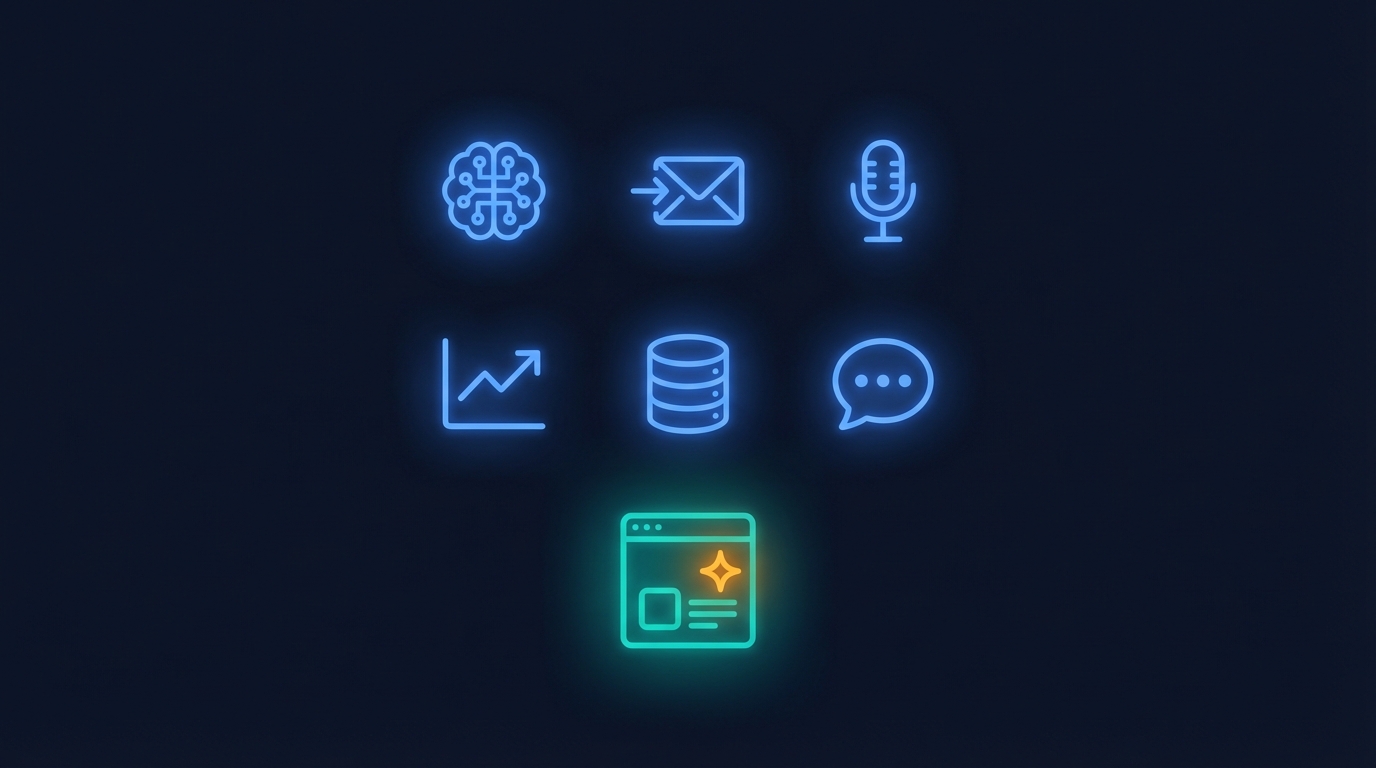
81% of sales teams have implemented or are experimenting with AI3. But here's what most comparison guides won't tell you: nearly every CRM ships the same six categories of AI features. Lead scoring, email generation, conversation intelligence, forecasting, data enrichment, chatbots. Useful, yes. Differentiated, no.
The one feature that actually changes the retention equation is the one almost nobody offers yet: letting each customer build their own workflow apps inside the CRM. This guide covers what every CRM has, what the best ones do differently, and the feature category that will separate winners from losers over the next two years.
Key Takeaways
- Sales teams using AI report 83% average sales growth, compared to 66% for teams without AI4. The impact is real, but only when the AI matches actual workflows.
- Every major CRM now ships the same 6 AI feature categories. The differentiation gap has collapsed.
- Companies that implemented AI in CRM experienced roughly 30% reduction in customer churn5. But that number only holds when the AI adapts to how each customer works.
- The missing feature: customer-facing app generation. One production deployment of this approach achieved 90.8% adoption and 89% day-30 retention.
What Are the 6 Standard CRM AI Features in 2026? #
45% of sales professionals now use AI weekly, with strong gains in deal size, win rates, and sales cycle efficiency6. The features they're using fall into six predictable categories. Here's what each one does and who does it best.
1. Predictive lead scoring #
AI ranks leads by likelihood to convert, using historical deal data, engagement signals, and firmographic information. Every sales team wants this. Most major CRMs deliver it.
Who does it well: Salesforce Einstein scores leads against your historical close data. HubSpot's predictive scoring is available on Enterprise plans. Zoho Zia flags high-probability leads with anomaly detection. Freshsales Freddy scores and routes leads automatically.
2. AI email generation #
The AI drafts outbound emails, follow-ups, and sequences based on CRM context: deal stage, contact history, recent activity. Sales reps edit and send rather than writing from scratch.
Who does it well: HubSpot Breeze generates emails with CRM-aware context across the full buyer journey. Salesforce Einstein drafts emails within the Sales Cloud. Monday.com's AI assistant writes emails contextualized to board data.
3. Conversation intelligence #
AI records, transcribes, and analyzes sales calls. It identifies talk-to-listen ratios, objections raised, competitor mentions, and action items. Managers use it for coaching. Reps use it for follow-up.
Who does it well: Salesforce Einstein Conversation Insights surfaces deal risks from call transcripts. HubSpot's conversation intelligence tags key moments and tracks coaching opportunities. Gong and Chorus integrate with most CRMs as specialized add-ons.
4. Sales forecasting #
AI predicts revenue outcomes by analyzing pipeline health, deal velocity, and historical close rates. The goal is to replace spreadsheet-based forecasting with data-driven projections.
Who does it well: Salesforce offers AI-powered forecast adjustments within Pipeline Inspection. HubSpot Breeze provides forecast confidence scores. Zoho Zia predicts deal outcomes and flags stalled opportunities.
5. Data enrichment #
AI automatically fills in missing contact and company data: job titles, company size, industry, technographic signals. Reduces manual research time for reps.
Who does it well: HubSpot Breeze Intelligence enriches contacts from a database of 200M+ business profiles. Salesforce integrates with third-party enrichment through AppExchange. Clearbit (now part of HubSpot) and ZoomInfo are the specialized leaders.
6. AI chatbots and assistants #
Conversational AI that handles inbound questions, qualifies leads, books meetings, and routes inquiries. Works 24/7 without human intervention.
Who does it well: HubSpot Breeze includes a customer-facing chatbot and an internal Copilot assistant. Salesforce Agentforce deploys autonomous agents that can handle multi-step service workflows. Zoho Zia acts as an in-app assistant for CRM queries.
How Does Salesforce Agentforce Compare to HubSpot Breeze? #
Salesforce Agentforce reached 18,500 customers processing over 3 billion monthly agent workflows2. HubSpot Breeze AI is embedded across all hubs and included in most plans. These are the two largest AI investments in CRM. Here's how they differ.
Salesforce Agentforce #
Agentforce is Salesforce's bet on autonomous AI agents. Agents can execute multi-step workflows: resolve a customer service ticket, update a record, send a follow-up, and escalate if needed. It's powerful but complex. Configuration requires understanding Salesforce's data model, permissions, and flow architecture. Best for large enterprises with dedicated Salesforce admins.
CEO Marc Benioff positioned Agentforce as the answer to the SaaSpocalypse, framing it as a shift from per-seat pricing to per-agent outcomes. The vision: instead of paying for seats, you pay for results.
HubSpot Breeze #
Breeze is HubSpot's approach to making AI accessible without enterprise complexity. It includes Breeze Copilot (an in-app assistant), Breeze Agents (prospecting, content, social, customer), and Breeze Intelligence (data enrichment). The advantage is simplicity: AI features are contextually embedded where reps already work.
The trade-off: Breeze is easier to adopt but less customizable. Every HubSpot customer gets the same Breeze features. A SaaS sales team and a real estate brokerage see the same AI capabilities.
The pattern both share #
Both Salesforce and HubSpot are adding AI that makes the vendor's product smarter. Neither is adding AI that makes the product different for each customer. Every account gets the same lead scoring model, the same email generator, the same chatbot. That works for generic sales processes. It breaks for teams with specialized workflows.
Why Do All These CRM AI Features Look the Same? #
73% of customers expect better personalization as technology advances7. Yet every major CRM delivers identical AI features to every customer. A real estate brokerage, a SaaS startup, and a manufacturing distributor all get the same lead scoring, the same email generator, the same forecast model.
Why? Because vendor-built AI features are designed for the average user. They have to work for millions of accounts without breaking for any of them. That means no industry-specific logic, no company-specific workflow rules, no team-specific prioritization criteria.
The result is a shrinking differentiation gap. If every CRM has the same six AI features, choosing between them comes down to price and ecosystem, not capability. That's bad for vendors trying to retain customers and bad for buyers who need workflows tailored to how their team actually sells. This is the same dynamic playing out across every vertical.
What would change the equation? Not better versions of the same six features. Something structurally different.
What Is the AI Feature Most CRMs Are Missing? #
Companies that implemented AI in CRM experienced roughly 30% reduction in customer churn5. But that number hides a critical detail: the churn reduction comes from AI that matches actual workflows, not from generic features that look the same for every account.
The missing feature is customer-facing app generation. Instead of giving every CRM customer the same AI features, let each customer build workflow apps tailored to their specific sales process.
What this looks like in practice #
A real estate brokerage team opens their CRM, types "show me today's listings ranked by days on market with one-tap price comparison to comps," and gets a working app connected to their real pipeline data.
A SaaS sales manager types "build me a renewal risk dashboard that flags accounts with declining usage and surfaces the last three touchpoints," and gets a custom tool their vendor-built CRM doesn't offer.
A manufacturing distributor types "create a territory planner that shows open quotes by region, weighted by margin and close probability," and gets something their CRM's forecasting module could never produce because it's too specific to their business.
Each of these is a real workflow that a real sales team needs. None of them exist as standard CRM features because they're too niche for any vendor to build for one customer. But they're exactly the kind of tool that drives daily usage, and daily usage is what prevents churn.
Why this is different from customization #
Traditional CRM customization means drag-and-drop dashboards, custom fields, and admin-configured workflows. Those are useful but limited. They don't generate new applications. They rearrange existing ones.
Customer-facing app generation creates entirely new tools: focused, single-purpose apps that connect to the CRM's real data and inherit its security model. The customer describes what they need in plain English. AI builds it. It goes live the same day.
For more on how this works technically, see our guide on vibe coding for enterprise.
Does Customer-Facing App Generation Actually Work? #
Gigacatalyst, a YC-backed white-label AI app builder, powers this pattern in production for B2B SaaS platforms. The results across 946 users: 90.8% adoption rate (users opened at least one custom app), 89% day-30 retention, and over 670 microapps built by customers for workflows the core product roadmap couldn't prioritize.
Those adoption numbers are significantly higher than typical CRM feature adoption. Standard CRM features see 30-50% adoption rates for new releases. 90.8% adoption suggests the demand for workflow-specific tools was already there. The product just needed a way to absorb it.
The apps customers built were specific, not complex. A shift handoff checklist. A compliance inspection form. A lead prioritizer ranked by custom criteria. Each one solved a problem too niche for the core product but real enough that someone would churn without it.
For CRM vendors, the implication is clear: the AI feature that produces the highest retention lift isn't a better chatbot or a smarter lead scorer. It's the ability to let each customer shape the product to fit how they actually sell.
If you're evaluating how to add this to your own product, the white-label AI app builder guide covers the architecture and integration process. For a broader framework on AI integration levels, see how to add AI to your B2B SaaS.
How Should You Evaluate CRM AI Features in 2026? #
51% of businesses now use CRM software8. If you're evaluating CRM AI features, here's a practical framework that goes beyond the standard comparison table.
For buyers evaluating CRM tools #
Ask these questions of every vendor:
- Which AI features are generic vs. customizable? Lead scoring that uses your historical data is more valuable than lead scoring that uses a generic model.
- Can I build workflow-specific tools? If your sales process has steps that don't map to the CRM's default pipeline, you need a way to build those workflows yourself.
- Does the AI learn from my data over time? The best CRM AI gets smarter as you use it. If the model is static, you're paying for features that don't compound.
- What's the adoption rate among my team's persona? An AI feature is only valuable if your reps actually use it. Ask for usage data, not just feature lists.
For CRM builders adding AI to their product #
The six standard features are table stakes. Your competition already has them. To differentiate:
- Let customers build their own apps. This is the highest-impact feature nobody else offers yet.
- Inherit your security model. Every AI-generated app must respect existing permissions.
- Include an app marketplace. Distribution matters more than generation. Let customers discover and share what others have built.
See Gigacatalyst in Action
We build the AI platform layer that sits on top of B2B SaaS products and lets customers create their own workflow apps. Connected to real data. Governed by your security model.
Gigacatalyst is a white-label AI app builder that B2B SaaS companies, including CRM platforms, embed into their product. Let your customers build the workflow apps your roadmap can't prioritize. Backed by Y Combinator. See how it works →
Footnotes #
-
DemandSage. "42 Latest CRM Statistics 2026." https://www.demandsage.com/crm-statistics/ 2026. ↩
-
Digital Applied. "HubSpot vs Salesforce 2026: AI Features and Pricing." https://www.digitalapplied.com/blog/hubspot-vs-salesforce-2026-pricing-ai-features-comparison 2026. ↩ ↩2
-
Autobound. "State of AI Sales Prospecting 2026." https://www.autobound.ai/blog/state-of-ai-sales-prospecting-2026 2026. ↩
-
Email Vendor Selection. "56 CRM Statistics You Should Know for 2026." https://www.emailvendorselection.com/crm-statistics/ 2026. ↩
-
BigContacts. "50+ CRM Statistics You Need to Know in 2026." https://www.bigcontacts.com/blog/crm-statistics/ 2026. ↩ ↩2
-
G2 Learning Hub. "The State of AI in CRM: A Sneak Peek Into 2026." https://learn.g2.com/state-of-ai-in-crm 2026. ↩
-
Salesforce. "What Are Customer Expectations?" https://www.salesforce.com/small-business/what-are-customer-expectations/ 2025. ↩
-
CRM.org. "45 CRM Statistics You Need to Know in 2026." https://crm.org/crmland/crm-statistics 2026. ↩