Vibe Coding for Enterprise: How B2B SaaS Companies Are Letting Customers Build Their Own Apps #
The Shift from Internal to Customer-Facing Vibe Coding #
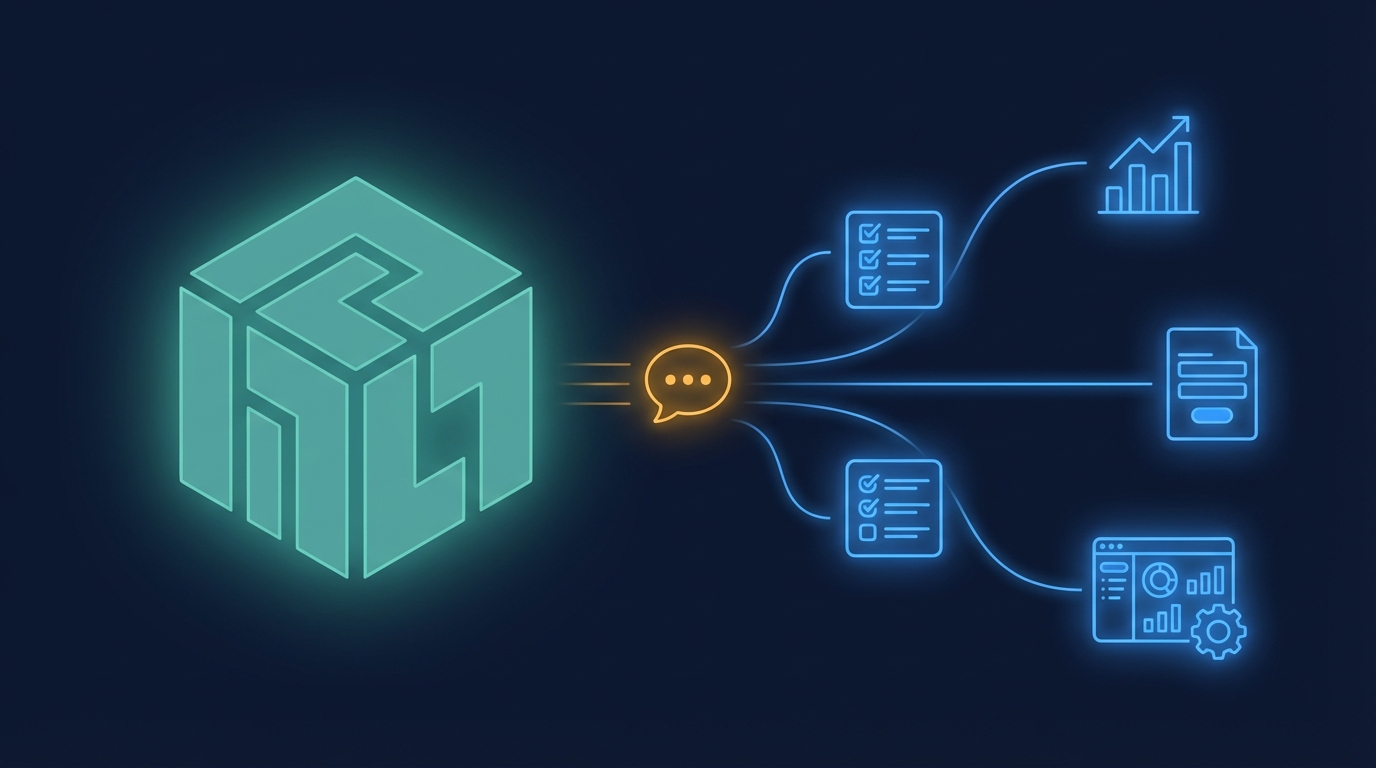
87% of Fortune 500 companies have adopted at least one vibe coding platform1. Most use these tools internally: engineers shipping features faster with Cursor, Copilot, or Replit. But the more interesting shift is happening on the other side of the product. A growing number of B2B SaaS companies are embedding vibe coding directly into their platforms, so their customers can build custom workflow apps in plain English. This is what 1,000 users did when given access to a production deployment.
This isn't about developers writing code faster. It's about non-technical business users describing what they need and getting a working application connected to real data, same day. Monday.com, Salesforce, Pega, and Microsoft are all racing here. And a wave of mid-market SaaS companies is following.
Here's what that shift looks like, why it matters, and how to evaluate whether your product should offer it.
Key Takeaways
- 63% of vibe coding users are already non-developers building full-stack apps and UIs1. The audience for this technology extends far beyond engineering.
- Enterprise feature requests get rejected at a 70-80% rate. Customer-facing vibe coding absorbs that demand without touching the product roadmap.
- Security is the hard part. 45% of AI-generated code contains OWASP Top-10 vulnerabilities2. Enterprise vibe coding requires governed, sandboxed environments with inherited security models.
- One production deployment achieved 90.8% adoption and 89% day-30 retention by letting customers build workflow apps inside a CMMS platform.
What Does Vibe Coding for Enterprise Actually Mean? #
92% of US developers now use AI coding tools daily, and 46% of all new code is AI-generated3. But "vibe coding for enterprise" means something specific. It's not about your engineering team using Copilot. It's about embedding AI-powered app generation into your SaaS product, so your customers build solutions themselves.
Internal vibe coding vs. customer-facing vibe coding #
Internal vibe coding is a developer productivity tool. An engineer opens Cursor, describes a feature, iterates on the output, and ships it through the normal release process. The customer never sees how the code was written.
Customer-facing vibe coding is a product feature. A maintenance manager opens your platform, types "show me which work orders are overdue by site, sorted by priority," and gets a working app connected to their real data. No engineering ticket. No release cycle. No waiting.
The distinction matters because the second version changes your product's economics. It turns a static SaaS product into a platform where every customer gets a personalized experience, without your engineering team building each one.
Who is actually vibe coding today? #
63% of vibe coding users are non-developers creating UIs, full-stack apps, and personal software tools1. This isn't a niche behavior. When Andrej Karpathy coined the term in early 2025, he described a mode of working where "you fully give in to the vibes, embrace exponentials, and forget that the code even exists." That ethos has already spread from developer side projects to enterprise product strategy.
Why Are SaaS Companies Letting Customers Build Their Own Apps? #
B2B SaaS churn averages 4.9% annually, with low product adoption as the primary driver4. When the software doesn't match the customer's specific workflow, usage drops. When usage drops, the tool becomes expendable during cost optimization cycles. The math is straightforward: every customer who can't do their actual job inside your platform is a churn risk.
The engineering bottleneck is real #
B2B SaaS founders report rejecting 70-80% of enterprise feature requests because they're too niche or too expensive to build for one customer5. Each rejected request is a customer whose workflow doesn't fit your product. Multiply that across hundreds of accounts and you get a structural adoption gap that no amount of core product development can close.
CFOs are already cutting underused SaaS #
63% of organizations say too many unused or underutilized SaaS apps drive consolidation decisions6. Gartner estimates that 25% overspending will result from unused entitlements and unnecessary overlapping tools by 20277. Your product is either essential to daily workflows or it's on the chopping block. There is very little middle ground.
Shadow IT fills the gap (badly) #
30-40% of IT spending in large organizations goes to shadow IT7. When your platform doesn't cover a workflow, customers build spreadsheet workarounds, unauthorized Zapier automations, and internal tools that live outside your security model. The demand for customization exists. The question is whether it happens inside your product or outside it.
What Are the Big Players Doing with Enterprise Vibe Coding? #
The largest SaaS companies are already building customer-facing vibe coding into their platforms. The pattern is consistent: let users describe what they need, generate a working app, connect it to the platform's data.
Monday.com Vibe #
Monday.com launched "Monday Vibe" to let users build custom apps inside the Monday ecosystem. Users describe what they want, and the platform generates functional applications that plug into existing Monday boards and data. It's a direct play to reduce churn by making the platform more adaptable to each customer's workflow.
Salesforce Agentforce #
Salesforce positioned Agentforce as its answer to the SaaSpocalypse. Agents operate inside the Salesforce ecosystem, executing tasks and building custom workflows using the platform's data and security model. CEO Marc Benioff has framed it as a shift from per-seat software to per-agent outcomes.
Pega Blueprint #
Pega updated Blueprint so enterprise teams can design and deploy apps through plain-language prompts. It targets the same problem: enterprises need custom applications faster than traditional development cycles allow. Pega's angle is compliance-heavy industries like financial services and healthcare.
Microsoft Power Apps #
Microsoft has leaned into "vibe coding for enterprise" with Power Apps, backed by Copilot integration. A Power Apps video titled "Vibe coding for enterprise? Yes, with Microsoft Power Apps!" has 15K views on YouTube, signaling real search demand for this concept. Microsoft's advantage is its existing enterprise distribution, but Power Apps still carries a meaningful learning curve compared to pure natural language generation.
The pattern #
Every major platform is converging on the same thesis: customers need to build custom apps inside your product, and AI makes that possible without requiring them to be engineers. The question for mid-market SaaS companies is whether they can build this themselves.
Can Mid-Market SaaS Companies Build This Themselves? #
IBM reports that development time for enterprise internal apps has dropped 60% using AI-assisted coding8. That sounds promising until you scope what "customer-facing vibe coding" actually requires. It's not just code generation. It's a multi-tenant AI runtime with security inheritance, a marketplace, governance, audit trails, and deployment infrastructure.
The build list is longer than it looks #
A customer-facing vibe coding feature requires:
- Multi-tenant AI runtime that isolates each customer's data and apps
- API auto-discovery so the AI can connect to your existing backend
- Security inheritance so generated apps respect your existing auth, permissions, and row-level access
- Code validation and sandboxing to prevent generated code from introducing vulnerabilities
- App marketplace for discovery, sharing, and governance
- Versioning and audit trails for compliance
- White-label theming so it looks native to your product
Building this from scratch is 6-12 months of dedicated engineering, minimum. For a mid-market SaaS company with 20-50 engineers, that's a significant chunk of the roadmap.
Security can't be an afterthought #
45% of AI-generated code samples contain OWASP Top-10 vulnerabilities, according to Databricks research2. 75% of R&D leaders express concern about data privacy and security risks with AI code generation1. For enterprise vibe coding, every generated app must run inside a governed sandbox that enforces the host platform's security model. That's a hard engineering problem that most teams underestimate.
"The median task completion time drops 20-45% for greenfield features using vibe coding. But in enterprise, the code isn't the bottleneck. Security, multi-tenancy, and governance are."
Hashnode, State of Vibe Coding 2026
How Does an Embedded AI App Builder Actually Work? #
The embed pattern solves the build-vs-buy problem by giving SaaS companies a white-label AI app builder that plugs into their existing product. The SaaS company doesn't build the AI runtime, the marketplace, or the governance layer. They integrate it, configure it for their APIs and security model, and ship it as a native feature.
The three-step pattern #
Step 1: Integrate. The AI builder connects to the SaaS platform's APIs, data model, design language, and security rules. It learns what endpoints exist, what data shapes look like, and what permissions apply. This typically takes two weeks.
Step 2: Describe. End-customers, or CS teams on their behalf, describe the workflow they want in natural language. "Show me which leads to call today, ranked by urgency." "Build an inspection checklist with mandatory photo uploads and manager sign-off."
Step 3: Deploy. The AI generates a production-ready microapp: a focused, single-purpose application that connects to real data, inherits existing permissions, and goes live the same day. No engineering ticket. No sprint planning.
What gets produced #
These aren't toy prototypes. Each generated microapp:
- Connects to the SaaS platform's real APIs and real customer data
- Inherits the platform's existing security model (row-level access, role-based permissions)
- Is versioned, auditable, and governed
- Can be shared through a built-in app marketplace
Gigacatalyst, a YC-backed white-label AI app builder, powers this exact pattern in production. The results across 946 users at one B2B SaaS customer: 90.8% adoption rate (users opened at least one custom app), 89% day-30 retention (users kept returning), and over 670 microapps built by customers for workflows the platform's own roadmap couldn't prioritize.
The adoption numbers are high because the apps match how each customer actually works. A hospital gets compliance inspection workflows. A roofing company gets a lead prioritizer. A fleet operator gets a maintenance scheduler. Same platform underneath. Completely different experience on top.
What Should You Evaluate When Choosing an Enterprise Vibe Coding Approach? #
Not every approach to customer-facing vibe coding is equal. Whether you build internally or embed a third-party solution, here's what matters.
Security inheritance is non-negotiable #
The AI builder must enforce your existing security model on every generated app. Row-level access, role-based permissions, tenant isolation. If the generated code can access data the user shouldn't see, the entire feature is a liability. 40% of junior developers admit to deploying AI-generated code they don't fully understand1. In an enterprise context, there must be zero reliance on the user to catch security issues.
Multi-tenancy must be native #
Each of your customers needs isolated data, isolated apps, and isolated AI configuration. This isn't something you bolt on after launch. Multi-tenancy needs to be architected from the foundation.
The marketplace matters more than the builder #
Generating apps is the flashy part. But the long-term value comes from distribution: a marketplace where customers discover, install, and share apps. Pre-built apps for common workflows drive initial adoption. Custom-built apps drive long-term retention. Without a marketplace, you have a tool. With one, you have a platform.
Evaluate against your alternatives #
| Approach | Speed | Security | Who builds | Learning curve |
|---|---|---|---|---|
| Custom engineering | Months | High (your team controls it) | Engineers | N/A |
| Low-code (Retool, Bubble) | Days | Separate auth system | Technical admins | Weeks |
| Generic AI generators (Cursor, Claude Code) | Hours | None (unmanaged) | Developers | Low |
| Embedded AI app builder | Same day | Inherited from platform | Anyone | Zero |
The right choice depends on your team size, your customers' technical sophistication, and how critical personalized workflows are to retention.
See Gigacatalyst in Action
We build the AI platform layer that sits on top of B2B SaaS products and lets customers create their own workflow apps. Connected to real data. Governed by your security model.
Gigacatalyst is a white-label AI app builder that B2B SaaS companies embed into their product. Customers describe workflows in plain English, get working apps same-day. Backed by Y Combinator. See how it works →
Footnotes #
-
Second Talent. "Top Vibe Coding Statistics & Trends [2026]." https://www.secondtalent.com/resources/vibe-coding-statistics/ 2026. ↩ ↩2 ↩3 ↩4 ↩5
-
Hashnode. "The state of vibe coding in 2026: Adoption won, now what?" https://hashnode.com/blog/state-of-vibe-coding-2026 2026. (Citing Databricks research on AI-generated code vulnerabilities.) ↩ ↩2
-
GitHub. AI-generated code statistics cited in Hashnode State of Vibe Coding 2026 and Second Talent reports. 2026. ↩
-
Vena Solutions. "2025 SaaS Churn Rate: Benchmarks, Formulas and Strategies." https://www.venasolutions.com/blog/saas-churn-rate 2025. ↩
-
Reddit r/SaaS. "B2B SaaS founders: What % of feature requests do you have to reject?" https://www.reddit.com/r/SaaS/comments/1qdrk75/ 2025. (Self-reported founder data, 70-80% rejection rate for enterprise feature requests.) ↩
-
BetterCloud. "The big list of 2026 SaaS statistics." https://www.bettercloud.com/monitor/saas-statistics/ 2026. ↩
-
Gartner. Shadow IT and SaaS overspending estimates cited in BetterCloud 2026 SaaS statistics compilation. 2025-2026. ↩ ↩2
-
IBM. Enterprise internal app development time reduction cited in Hashnode State of Vibe Coding 2026. 2026. ↩