Are You Building for Your Team or for Your Customers? #
Gartner projects that 75% of new applications will be built on low-code platforms by 20261. That's a staggering shift. But the word "application" hides a fork in the road that most comparison articles ignore: are you building tools for your own employees, or tools for your customers?
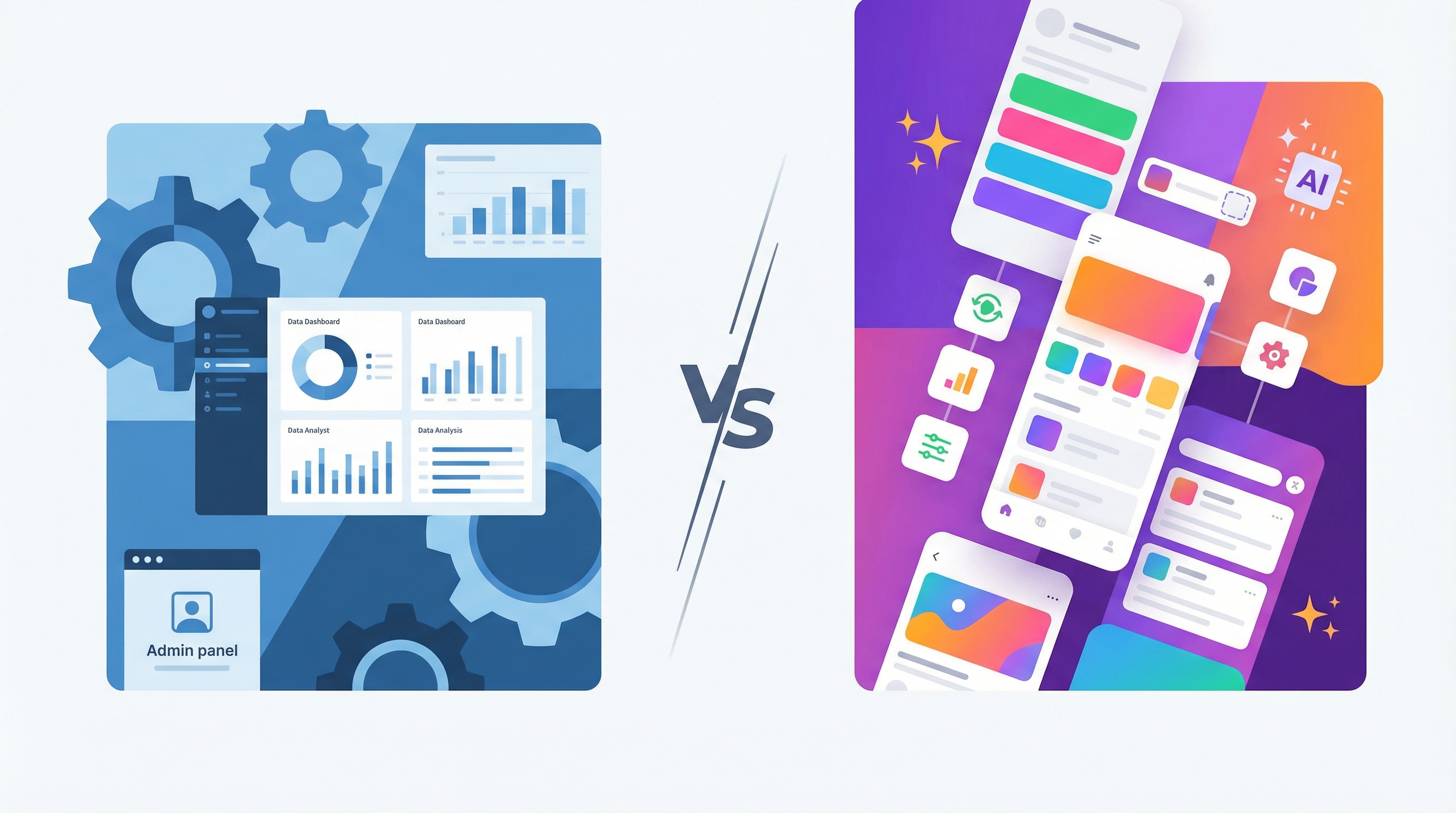
Retool and Gigacatalyst both let you build apps with AI. They both connect to your data. They both promise faster time to value. But they solve fundamentally different problems. Retool is the leading platform for internal tools: admin panels, dashboards, customer support interfaces your team uses behind the scenes. Gigacatalyst is built for the opposite direction: AI-generated apps your customers use, embedded directly inside your SaaS product.
Pick the wrong one and you'll spend months forcing a tool to do a job it wasn't designed for. Here's how to decide.
Key Takeaways
- Retool excels at internal tools for your engineering and ops teams, with pricing starting at $10/builder/month
- Gigacatalyst generates customer-facing apps embedded in your SaaS product, with 90.8% end-user adoption in production
- The deciding factor: if your end user is an employee, choose Retool. If your end user is a customer, choose Gigacatalyst
Quick Comparison: Retool vs Gigacatalyst #
| Dimension | Retool | Gigacatalyst |
|---|---|---|
| Primary use case | Internal tools and admin panels | Customer-facing apps inside your SaaS |
| Who builds | Your developers and power users | Your CS team, or AI generates per customer |
| End user | Your employees | Your customers |
| AI generation | AppGen (prompt-to-app for internal tools) | AI agent builds per-customer workflow apps |
| Deployment model | Retool cloud or self-hosted | White-label, embedded in your product |
| Pricing model | Per builder + per internal user | Per SaaS tenant (embedded) |
| Time to first app | Minutes (with AppGen) | Minutes (AI-generated per customer) |
| Multi-tenancy | Workspace-level isolation | Built-in per-customer data isolation |
| Best for | Ops teams needing dashboards, CRUD apps | B2B SaaS companies reducing churn through customization |
What Is Retool and Who Should Use It? #
Retool is the market leader for building internal tools, trusted by over 10,000 teams including Amazon, Boeing, and DoorDash2. The platform generated $138.6 million in revenue in 2024 and carries a $3.2 billion valuation3. It's a serious product with serious traction.
Strengths #
- Mature component library. Pre-built tables, forms, charts, and modals that handle pagination, filtering, and actions out of the box. You drag, drop, and connect to a database.
- Deep integrations. Connects natively to PostgreSQL, MySQL, MongoDB, REST APIs, GraphQL, and dozens of third-party services. Your data stays where it is.
- Enterprise AppGen. Launched in October 2025, Retool's AI can generate full internal apps from natural language prompts. Describe what you need, and the AI builds it against your actual schemas4.
- Governance built in. SSO, role-based access control, audit logging, and self-hosted deployment options. Enterprise IT teams trust it.
- Massive community. Years of templates, tutorials, and community forums. If you're stuck, someone has solved it before.
Weaknesses #
- Internal-only by design. Retool is built for tools your employees use. It's not designed to be embedded inside your SaaS product as a customer-facing feature.
- Per-user pricing adds up. The Business plan costs $50/builder and $15/internal user per month. For large teams, costs climb fast5.
- Builder-dependent. Someone on your team still needs to build and maintain each app. Even with AppGen, the human is the builder, not the AI acting autonomously per customer.
- No per-customer personalization. Every user of a Retool app sees the same interface. You can filter data by role, but the app itself doesn't morph to match individual customer workflows.
Best for #
Engineering teams, ops managers, and internal tooling groups who need dashboards, admin panels, and CRUD interfaces. If your developers spend hours building one-off internal scripts, Retool replaces that work in minutes.
What Is Gigacatalyst and Who Should Use It? #
Gigacatalyst is a Y Combinator-backed platform that lets B2B SaaS companies offer AI-generated apps to their customers. Instead of building a single app that every customer uses, Catalyst's AI generates different apps per customer, per persona, per workflow.
Strengths #
- Customer-facing by design. The apps Catalyst generates are meant for your customers, not your team. They embed directly inside your SaaS product as a white-label feature.
- AI generates per customer. The AI agent discovers your API surface, reads your schema, and builds apps tailored to each customer's specific workflow. A hospital gets different apps than a roofing company, even on the same platform.
- Zero engineering cost per customer. CS teams describe what a customer needs. The AI builds it. No engineering tickets, no sprint planning, no backlog. In production at one B2B SaaS platform, this model achieved 90.8% adoption across 946 users6.
- Multi-tenant isolation built in. Every generated app inherits the host platform's security model: same API permissions, same row-level access, same audit trail. Customer A never sees customer B's data.
- Same-day deployment. From description to working app in the same day. Integration into an existing SaaS product takes roughly two weeks6.
Weaknesses #
- Not for internal tools. If you need a quick admin panel for your ops team, Catalyst isn't the right fit. It's purpose-built for customer-facing use cases.
- Newer platform. Retool has been in market since 2017 with thousands of enterprise deployments. Catalyst is earlier stage, though YC-backed with production deployments.
- Requires an existing SaaS product. Catalyst embeds into your platform. If you don't have a SaaS product with an API, there's nothing to embed into.
Best for #
B2B SaaS companies whose customers have diverse workflows and keep asking for "just one more feature." If your CS team fields customization requests that never make the roadmap, Catalyst turns those requests into apps without engineering effort.
Head-to-Head: Who Builds the App? #
In Retool, a human builds every app. That human might use AI to speed things up (AppGen generates a first draft from a prompt), but someone on your team still owns the creation, iteration, and maintenance. Retool's own 2025 Builder Report found that 91% of builders say AI changed how they work, and nearly half of non-engineers can now build directly4. That's a real expansion of who can build internal tools.
Gigacatalyst inverts this model. The AI is the primary builder. It discovers your API surface, generates the app, validates the code through multiple gates (compile checks, schema validation, security enforcement), and deploys it. The human provides a description. The AI does the rest.
Why does this matter? Scale. A human builder can create dozens of internal apps. An AI builder can generate hundreds of customer-specific apps. If you need one dashboard for your sales team, a human builder is fine. If you need a different workflow app for each of your 500 customers, you need the AI to do the building.
Head-to-Head: Pricing at Scale #
Retool charges per user. The free tier covers up to 5 users. The Team plan starts at $10/builder plus $5/internal user per month. The Business plan jumps to $50/builder and $15/user. Enterprise pricing is custom5.
For a team of 10 builders and 50 internal users, the Business plan costs roughly $1,250/month. For 100 internal users, that's $2,000/month. Costs scale linearly with headcount.
Gigacatalyst uses a per-tenant model. You're paying for the platform embedded in your SaaS, not per end user. When the AI generates a new app for a new customer, the marginal cost is near zero. This model makes more sense when your end users number in the hundreds or thousands, because they're your customers, not your employees.
The question isn't which is cheaper. It's which pricing model matches your use case. Per-user pricing works for internal teams with a known headcount. Per-tenant pricing works when the number of end users is large and growing.
Head-to-Head: Security and Governance #
Both platforms take security seriously, but from different angles.
Retool offers SSO, RBAC, audit logging, SOC 2 compliance, and self-hosted deployment. Every action in every Retool app is audited. You can run Retool entirely within your own infrastructure4. For internal tools handling sensitive data, this is exactly what enterprise IT requires.
Gigacatalyst inherits the host platform's security model. Generated apps connect only through approved APIs. They run inside a sandboxed runtime. They pass validation gates before deployment. The security posture matches whatever the host SaaS already enforces. This matters because the apps are customer-facing: your customers expect the same security guarantees they get from the rest of your product.
Neither approach is "more secure." Retool governs from the top down (IT controls the platform). Catalyst governs from the inside out (the host SaaS controls what the AI can access). The right model depends on whether the end user is inside or outside your organization.
How to Choose the Right Platform #
The single most important question: who is the end user of the apps you're building?
Choose Retool when: #
- You need internal admin panels, dashboards, or CRUD tools
- Your developers spend too much time building one-off internal scripts
- You want your ops team to self-serve reporting and data management
- You need deep database connectivity for internal workflows
Choose Gigacatalyst when: #
- Your SaaS customers keep requesting features you can't build fast enough
- You want to offer per-customer workflow apps without growing your engineering team
- Your CS team handles customization requests that never make the product roadmap
- You're losing customers because your product doesn't fit their specific workflow
Consider both when: #
- You need internal tools for your team (Retool) AND want to offer AI-powered customization to your customers (Catalyst)
- You're a B2B SaaS company with both internal ops needs and customer-facing flexibility gaps
The diagnostic question: When you picture the person opening the app you're about to build, are they on your payroll or on your customer list? That answer picks the platform.
We've seen B2B SaaS companies try to use internal tool builders for customer-facing use cases. It usually stalls at multi-tenancy. Internal tools assume a shared workspace. Customer-facing apps require per-tenant isolation, white-labeling, and the host product's auth model. Retrofitting one for the other costs more time than starting with the right tool.
The Right Tool for the Right Job #
The low-code market is projected to reach $58.2 billion by 20291. Both Retool and Gigacatalyst ride that wave, but they ride it in opposite directions. Retool points inward, giving your team faster ways to build the tools they need. Catalyst points outward, giving your customers apps that match how they actually work.
If you're evaluating "no-code tools for SaaS," start with the end user. Internal teams get Retool. Customer-facing flexibility gets Catalyst. The best B2B SaaS companies will likely need both.
See Gigacatalyst in Action
Watch how B2B SaaS companies generate customer-facing apps with AI, without engineering tickets.
Footnotes #
-
Gartner. "Forecast Analysis: Low-Code Development Technologies, Worldwide." https://www.gartner.com/en/documents/7146430 2025. ↩ ↩2
-
Retool. "AI App Generation for Enterprise." https://retool.com/ai-app-generation 2025. ↩
-
Latka, Nathan. "How Retool Hit $138.6M Revenue." https://getlatka.com/companies/retool 2024. ↩
-
Retool. "Introducing Enterprise AppGen." https://retool.com/blog/introducing-enterprise-appgen 2025. ↩ ↩2 ↩3
-
Retool. "Pricing." https://retool.com/pricing 2026. ↩ ↩2
-
Gigacatalyst internal deployment data, UpKeep production environment. 2025. ↩ ↩2