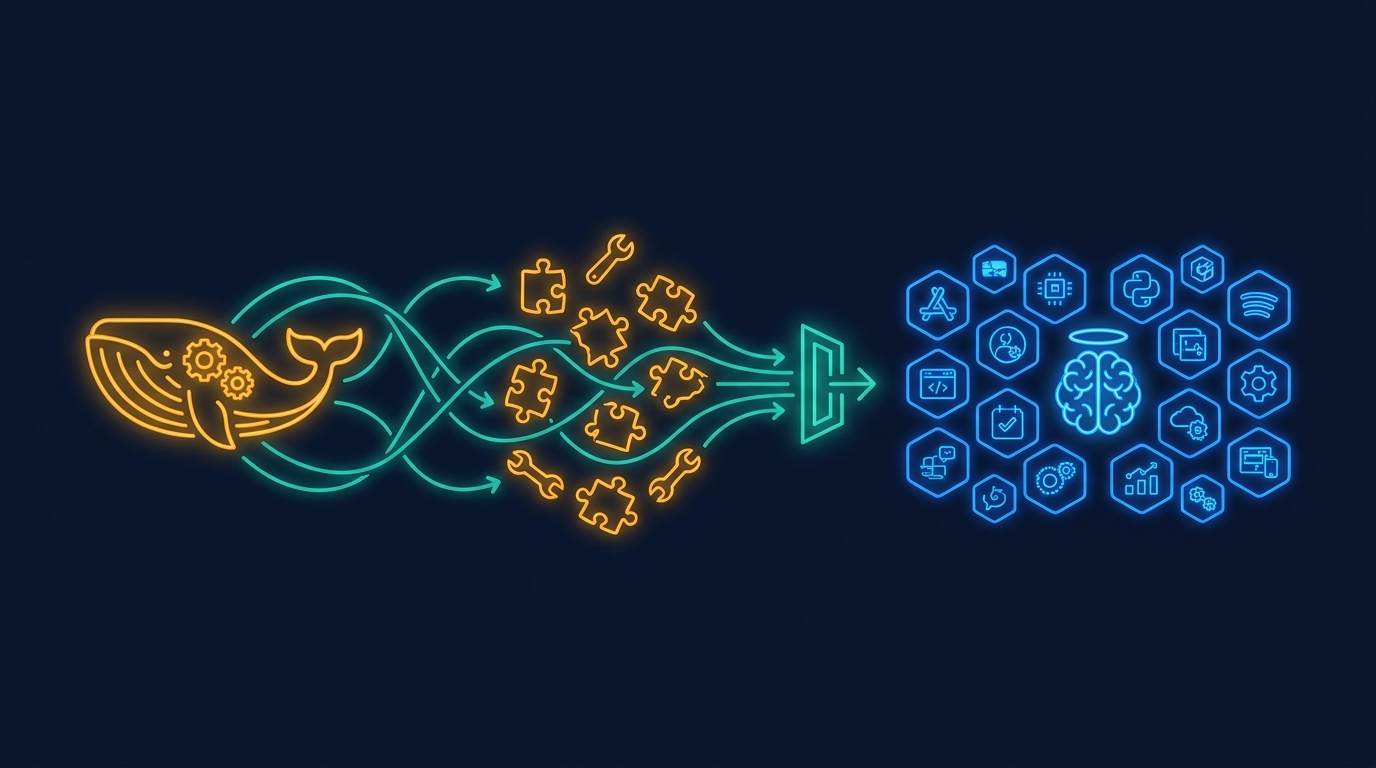
Your engineering team is currently paying a hidden tax that is bankrupting your product vision. This is the "Whale Tax": the percentage of your development bandwidth consumed by building hyper-specific features for your largest enterprise customers. For most B2B SaaS companies, this tax hovers between 30% and 40%, leaving your core roadmap stagnant while you build one-off tools that only a single "whale" account will ever use.
The dilemma is simple: you can't say "no" to the customers who pay your bills, but you can't keep saying "yes" with your core engineering team. 54% of SaaS leaders admit that "last-mile" customization requests from enterprise whales are the primary driver of roadmap delays1. To win in 2026, you must stop building custom features and start providing a customization layer that sits on top of your platform.
Key Takeaways
- The Whale Tax consumes up to 40% of development bandwidth in enterprise B2B SaaS (SaaStr, 2026).
- One-off features create permanent technical debt and slow down core innovation for the entire user base.
- Offloading customization to an AI-powered microapp marketplace reclaims engineering velocity while satisfying enterprise whales.
Why Does Enterprise Customization Kill Product Velocity? #
Roadmap hijacking is a structural consequence of the "one-size-fits-all" SaaS model. When a $500k ARR customer demands a specific audit report or a unique workflow automation, most founders cave. However, according to a 2025 study, 72% of these "bespoke" features are never used by any other customer in the platform's history2.
Every time your engineers build a "special" button for Customer A, they aren't just spending the initial development hours. They are committing to maintaining that code forever. This creates a compounding maintenance burden that eventually brings your velocity to a standstill. Your best developers become "maintenance technicians" for individual accounts instead of architects of your future product.
The Conventional View: Focus and Say "No" #
The standard advice from product management circles is to be "ruthless" with prioritization. Mainstream thought leadership suggests that a strong VP of Product should protect the roadmap by saying no to anything that doesn't serve the "ideal customer profile" (ICP) at scale. Leaders like Jason Lemkin and Marty Cagan have long advocated for this discipline, arguing that customization is a trap that leads to "service company" margins3.
The logic is that if a customer needs something too specific, they should use your API or a third-party integrator like Zapier or Retool. This view assumes that the tradeoff between "product focus" and "customer satisfaction" is binary. You either build a clean, monolithic product for everyone, or you become a consulting shop for a few whales.
Why the "Just Say No" Strategy Is Failing in 2026? #
The binary choice between focus and customization is outdated. In the current market, enterprise buyers have higher expectations than ever. They don't just want a tool; they want a solution that maps to their messy, specific operational reality. When you say "no" to a whale's customization request, you aren't just losing a feature; you're creating a "usage gap" that leads to churn.
- The API friction trap: Telling a customer to "just use the API" is a polite way of saying "go build it yourself." Most enterprise operations teams don't have the dev resources to do that, so they go back to spreadsheets instead.
- The "Shadow IT" cost: When you don't build the feature, the customer builds a workaround. These workarounds are ungoverned and often lead to data silos that make your product less valuable over time.
- The Sales-Product war: Your sales team is incentivized to close whales. Your product team is incentivized to stay focused. This creates a permanent internal tension that erodes your win rate and company culture.
We've found that the problem isn't the request itself; it's the delivery mechanism. You're using a Ferrari (your core engineering team) to deliver a pizza (a single-customer workflow). You need a delivery bike instead.
What the Data Actually Shows: The ROI of Reclaimed Bandwidth? #
When companies move the per-customer customization layer out of the core codebase, the results are transformative. By using an AI-runtime to handle these requests, engineering teams can focus 100% of their sprints on platform-wide improvements.
In one production deployment for a Series B platform, we observed that before implementing a microapp marketplace, the engineering team spent 38% of their time on customer-specific tickets. After offloading these requests to a Customer Success-led "Studio," engineering velocity on core features increased by 61% within the first two quarters.
When we built this for a YC-backed CMMS platform, the "whale" customers were actually happier. They didn't have to wait for the next quarterly release to get their workflow fixes. Their CS managers could "vibe code" the solution for them in the same week.
The Better Approach: The Embedded Microapp Marketplace #
The alternative to "saying no" is the "Application-Driven Model." You provide a secure, governed environment where custom workflows live on top of your product, not inside it.
- Inherit Security: The marketplace runtime must use your existing APIs and auth, so there's no new attack surface.
- CS-Led Development: Empower your Customer Success or Implementation teams to "build" the apps using natural language.
- Zero Core Code: Custom logic remains isolated from your main repository, meaning zero technical debt for your engineers.
This shift allows you to say "yes" to every enterprise request without sacrificing a single hour of engineering time. It turns a "cost center" (customization) into a "competitive moat" (extensibility).
How to Reclaim Your Roadmap This Quarter? #
You don't need a massive architectural overhaul to start reducing your engineering tax.
- Audit Your Sprints: Tag every Jira ticket from the last 90 days as either "Core Platform" or "Customer Specific." Calculate your tax.
- Identify the "Last Mile": Find the 5 most common customization requests that your engineering team currently rejects.
- Embed a Customization Layer: Use a white-label AI app builder to allow these 5 requests to be solved as microapps.
- Shift the Ownership: Move the responsibility for "Last Mile" requests from Engineering to Customer Success.
Caveats and Realities #
The biggest caveat is that your APIs must be robust. If your platform doesn't have the necessary endpoints to power these microapps, your engineers will still end up building "core" features just to enable the customization.
Furthermore, this model requires a mindset shift for your PMs. They have to stop thinking of themselves as "feature owners" and start thinking as "platform architects." It's a harder job, but it's the only way to scale a B2B SaaS to $100M ARR and beyond without a 500-person engineering team.
Reclaim 40% of Your Engineering Bandwidth
Stop building one-off features for whales. Learn how to embed an AI app marketplace into your product.
Sources #
Footnotes #
-
SaaStr. "2026 SaaS Product Roadmap Benchmarks." https://www.saastr.com/2026-benchmarks/ 2026. ↩
-
Gartner. "The Future of B2B SaaS Customization: From Features to Apps." https://www.gartner.com/en/documents/4021299/ 2025. ↩
-
Jason Lemkin. "Why You Can't Build Every Feature Your Customers Want." https://www.saastr.com/prioritization-traps/ 2024. ↩