92% of SaaS companies plan to increase their AI spending this year1. Yet average B2B SaaS churn still sits at 3.5% per month2. If everyone is shipping AI features, why isn't retention improving?
Most SaaS teams ship surface-level AI. The features look impressive in demos but don't change how customers work day to day.
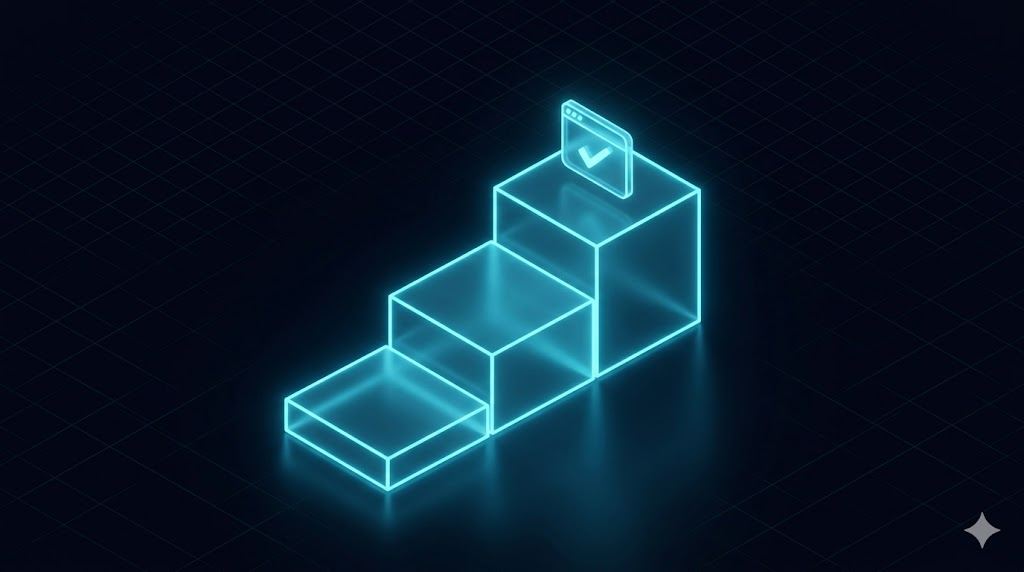
There's a better way to think about this: After building AI features across multiple B2B SaaS products, we've identified three distinct levels of AI integration. Each requires different architecture, different investment, and produces dramatically different outcomes.
Key Takeaways
- Level 1: AI calls that take input and run API calls. Fast to ship, but minimal impact.
- Level 2: Chat-based AI with tool use and memory. Better UX, but still generic across customers.
- Level 3: AI that builds full workflow applications per customer. Highest impact, 90% retention in hundreds of cases.
Level 1 AI: The input box #
It's the most common AI in SaaS today: AI API calls where a user submits input, the AI returns structured output.
The input is user's raw data like a photo or text. The output is structured data.
This is genuinely useful for reducing manual data entry: workers filling out forms, teams classifying tickets, sales reps logging notes. And the engineering cost is low.
But, every customer gets the exact same flow. Level 1 AI is fast, useful, and completely identical for every customer. It reduces friction without reducing churn.
The Personalization Trap
Deploy Generic Feature
95% Churn Risk: Generic features leave most workflows unaddressed.
Deploy Level 3 (App Gen)
100% Fit: Level 3 AI perfectly builds to every customer's unique workflow.
Level 2: Conversational AI #
Most SaaS are pushing toward Level 2: conversational AI with tool use and memory. And roughly a third report they've begun scaling AI programs across their enterprise.
What changes from Level 1 #
The AI holds a conversation and it calls tools to read and write data across your product. The user is having a back-and-forth: "Show me the last 10 work orders." "Now filter to just the urgent ones." "Create a summary report."
Level 2 gets interesting when you customize the AI's behavior per customer. But still, chat is a mediocre interface for operational workflows. Business uers don't want to have a conversation, they want a button that does the thing.
The output is also ephemeral. The conversation ends and the value disappears. You can't install it, version it, or put it in a marketplace.
Chat-based AI is a better interface for exploration. But operational users don't explore, they execute. The gap between "ask the AI" and "use the app" is where Level 2 stalls.
Value Decay vs. Value Compounding
Time since initial customer deployment.
Level 2: AI Chat
Level 3: App Gen
Level 3: What Changes When AI Generates Entire Applications? #
Level 3 is where AI stops assisting and starts building. The vibe coding market reached $4.7 billion in 2025 with a 38% compound annual growth rate3.
From conversation to creation #
The AI at Level 3 means a builder agent.
It can understand your API, then generate complete applications, not snippets or suggestions, but full React or HTML apps with forms, tables, charts, filters, and business logic.
Before any generated app is returned, it passes through multiple checks, so this isn't "hope the AI got it right." It's a governed pipeline that guarantees the output works.
Why Level 3 solves what Level 1 and 2 cannot #
The output is an installable, shareable application, not a chat response that disappears when you close the tab. Every customer gets a different app tailored to their workflow, data, and role. And non-technical users, CS teams, operations managers, can build without writing code.
In production at one B2B SaaS platform, AI-generated apps achieved 90% day-30 retention across 1,000 users. It worked because they matched how each customer actually operates, not because the AI was impressive but because the output was useful.
Addressing the "comprehension debt" concern #
Arvid Kahl and others have argued that AI-generated code creates "comprehension debt" because nobody understands what the AI produced. This is a valid concern for general-purpose code generation, where developers must read, review, and maintain what an AI writes.
It does not apply to governed apps since it connects only through approved APIs and the end user never sees or maintains the code. They see the working application.
How Do the Three Levels Compare on Metrics That Matter? #
41% of all code written in 2026 is AI-generated3. But the value of that code depends entirely on what level produced it. Here's how the three levels stack up on the dimensions SaaS leaders actually care about.
| Dimension | Level 1: Extraction | Level 2: Chat | Level 3: App Generation |
|---|---|---|---|
| Engineering cost | Low (one API route) | Medium (agent infrastructure, prompt tuning) | High to build, zero per customer |
| Time to value | Seconds | Minutes per conversation | Minutes per application |
| Personalization | None (identical for all) | Per-tenant prompts | Per-customer, per-persona apps |
| Output durability | None (one-shot) | Session-length | Permanent (installable, shareable) |
| Churn impact | Minimal | Moderate | High (workflow-level stickiness) |
What Does It Take to Move From Level 1 to Level 3? #
33% of organizations with 1,000+ employees have already deployed agentic AI, and another 48% expect to within 12 months4. The first step is assessing whether your SaaS is ready. The question after that is whether you build the infrastructure yourself or adopt a platform designed for it.
From Level 1 to Level 2: build or buy agent infrastructure #
The jump from Level 1 to Level 2 is an engineering project. You need conversation state management, tool-calling agent loops, and streaming responses.
Realistic timeline: 2-4 engineering months for a competent team.
From Level 2 to Level 3: the hard part #
Level 3 requires a fundamentally different stack. You need an API discovery layer so the AI understands what your platform can do. You need code generation with multi-stage validation: compile checks, schema validation, security enforcement. You need a design system so generated apps look native to your product. You need app distribution: a marketplace, versioning, sharing, install/uninstall tracking.
Realistic timeline: 6-12 engineering months if building from scratch. Or you can adopt a platform purpose-built for this. Gigacatalyst, for example, ships this entire stack as an embeddable layer. SaaS companies deploying it went from zero to production in under 2 weeks with zero changes to their own codebase, compared to the 18 months of focused engineering it took to build the platform itself.
Skip straight to Level 3
Gigacatalyst gives your SaaS an embeddable AI app builder with marketplace, security, and multi-tenant isolation included. Your CS team ships custom apps for every customer, same day.
Does Upgrading AI Levels Actually Reduce Churn? #
The global AI SaaS market is growing at 38.28% CAGR, projected to reach $775 billion by 20315. But market growth does not mean your AI features reduce churn. The connection between AI sophistication and retention only becomes measurable at Level 3.
Here's why. Level 1 reduces friction but doesn't change whether a customer uses your product every day. Level 2 improves discovery but the value disappears when the conversation ends.
Level 3 creates installable applications that become part of the customer's daily workflow. When the app matches the workflow, usage goes up. When usage is high, the tool survives cost-cutting cycles.
92% of US developers use AI coding tools daily3. That stickiness comes from the output being integral to how they work. The same principle applies to SaaS customers using AI-generated workflow apps.
AI features don't reduce churn. AI features that change daily workflow behavior reduce churn. The difference is whether the output is ephemeral or durable, whether it vanishes after one interaction or becomes the tool someone opens every morning.
Where Does Your SaaS Sit on the AI Ladder? #
Most SaaS companies are at Level 1. Some are building toward Level 2. Very few have reached Level 3, where AI generates personalized workflow applications per customer and retention compounds because the output matches how people actually work.
Most SaaS churn isn't a feature problem. It's a personalization problem. Your customers aren't the same person. They have different roles, different workflows, different priorities. AI at Level 3 solves personalization at scale without changing your core product.
92% of SaaS companies are increasing their AI budgets. The question is no longer whether to invest. It's which level to invest in.
Footnotes #
-
SaaS Capital (2025). AI Adoption Among Private SaaS Companies ↩
-
IcebergIQ (2025). 10 SaaS Win-Loss Trends from 2025 ↩
-
Taskade (2026). State of Vibe Coding ↩ ↩2 ↩3
-
Battery Ventures (2025). State of Cloud Software Spending ↩
-
BetterCloud (2026). State of SaaSOps ↩