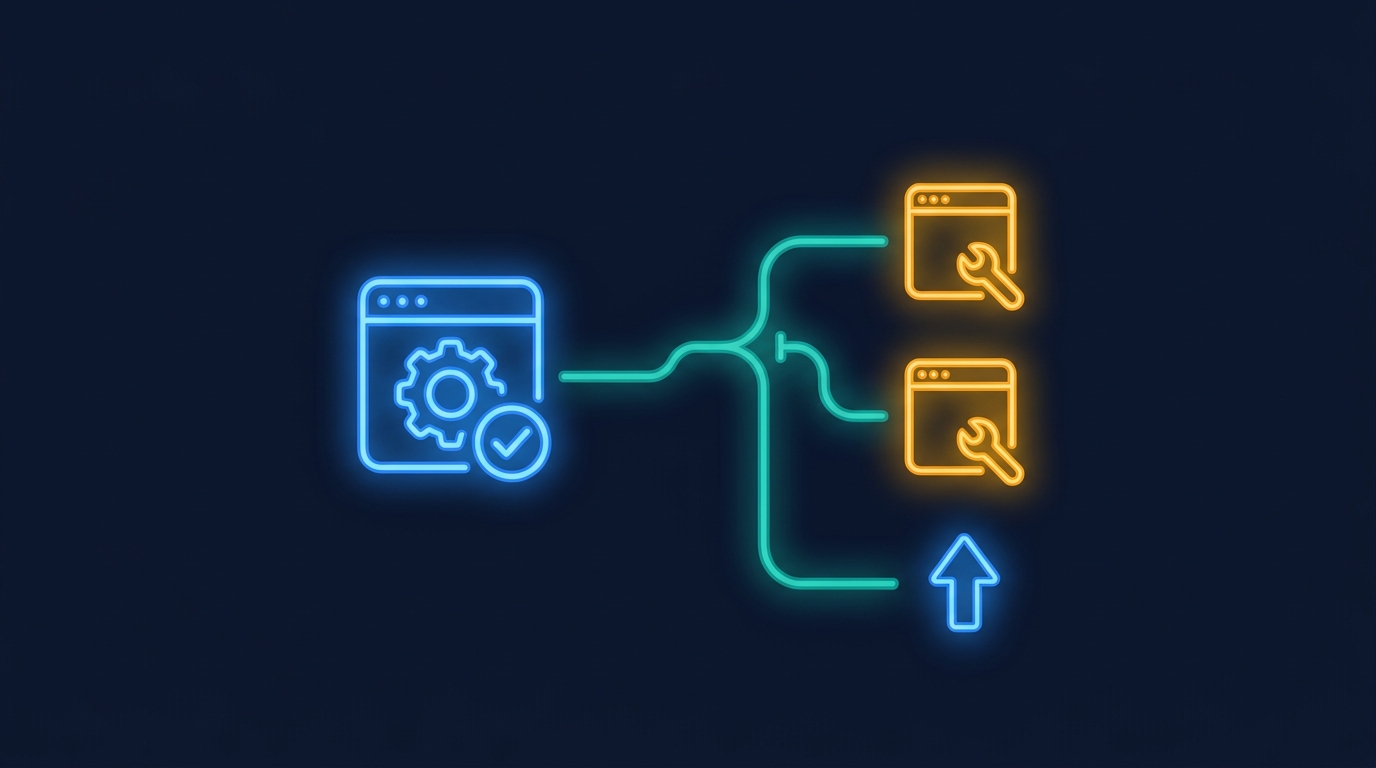
A business app builder gets easier to adopt when users do not have to start from a blank prompt.
That was the clearest lesson from a fintech SaaS call. The founder's customers all wanted slightly different invoice workflows. One person wanted open invoices. Another wanted overdue invoices. One manager cared about 30 days overdue. Another cared about 45. The product team could keep adding options to one dashboard, but the better pattern was simpler: give users a useful app, let them copy it, and let them change the few details that matter to their workflow.
That copy step matters more than most teams think. It turns an AI builder from a toy into an operating surface.
Key Takeaways
- "Business app builder" is an active 2026 search category, with teams comparing tools for dashboards, portals, trackers, approvals, and workflow apps.1
- Blank prompts slow adoption because most users know what they want only after they see a close example.
- Forkable apps give B2B SaaS companies a safer app store pattern: start with approved templates, then let each customer adapt them inside the same permissions and UI.
Why do blank prompts slow down business app builders? #
Blank prompts slow down business app builders because most business users do not think in app specifications.
They think in annoyances. "I need the overdue invoices my team actually acts on." "I need a weekly summary for this region." "I need the technician view, not the executive view." Those are real needs, but they are not clean product briefs.
This is why the first useful layer is often not a chat box. It is a small set of working apps that show what good looks like. The user can open one, use it, and then say, "make this one for my team, but use our 45-day rule."
That is a much easier request than asking a non-technical user to invent the whole app from scratch.
What does a forkable app change? #
A forkable app changes the user's job from authoring software to adapting something that already works.
On the fintech call, the examples were narrow but important: invoice dashboards, number tiles, weekly summaries, and customer-specific KPI definitions. A single generic dashboard would keep collecting filters. A forkable app store lets the product team publish one good starting point, then lets each account create the version it actually needs.
In a production B2B SaaS deployment, this pattern showed up quickly. First-party apps gave customers a taste of what was possible. The most useful behavior was the copy or fork action. A user did not have to understand the whole builder. They could start from a working app, change the prompt, and share the result with their team.
That is a different adoption motion from traditional no-code. The first app is not a project. It is a modification.
Why is this safer than letting everyone build from scratch? #
Forkable apps are safer because the starting point can be approved before customers customize it.
The SaaS vendor can decide which APIs the app may call, which components it uses, which roles can see it, and which actions require review. When a customer forks the app, the generated version still lives inside the product boundary. It uses the same login, the same row-level permissions, and the same design system.
That does not remove the need for governance. It makes governance easier to apply. The vendor can treat a first-party app as the known-good pattern, then control how far a fork is allowed to move from it before review.
This matters for enterprise buyers. A business app builder that creates a loose side tool creates a new problem for IT. A builder that forks approved in-product apps can give the business speed without sending data into another workspace.
How should a SaaS app store be seeded? #
A SaaS app store should be seeded with the workflows customers already keep asking for.
Do not begin with a giant marketplace. Begin with the repeat complaints from sales calls, onboarding, support, and customer success. If five customers ask for a different invoice aging view, publish a clean invoice workflow app. If frontline users keep asking for a mobile work order scanner, publish that. If executives keep asking for a location rollup, publish a focused executive view.
The goal is not volume. A marketplace with fifty unused apps is worse than a small store where the first five apps get copied every week.
The best first-party apps should be boring in a useful way. They should solve a known workflow, use live customer data, and be narrow enough that a user can understand what to change.
What should product teams measure after the fork? #
Product teams should measure whether forked apps become repeated work, not whether the app store looks full.
Track which apps are copied, edited, shared, installed, opened again, abandoned, and promoted into wider use. Those events tell product which customer-specific needs are one-offs and which ones are becoming patterns.
This is where the business app builder becomes more than a customization layer. It becomes a better feature request system. A request says what a customer asked for. A forked app with repeat usage shows what the customer cared enough to adapt and keep using.
In one B2B SaaS deployment, more than 2,000 apps were built inside the host product. Activation reached about 90% without training, and 89% of users were still active after 30 days. The important part was not only the count. It was the usage signal after publish.2
When should a forked app become a core feature? #
A forked app should become a core feature only when usage proves the need is broad.
If one account creates a strange weekly invoice summary for its own team, keep it as an app. If many accounts copy the same template and make the same small change, product should study it. That is a stronger signal than a backlog vote because the customer already spent effort to create the workflow.
This is how a SaaS company can protect the core product. Customer-specific work does not have to become another global setting. It can live as an app until the usage pattern proves it deserves a permanent place.
For B2B SaaS, that is the real app store strategy. Let customers move fast on the long tail, but make the long tail observable.
Want customers to fork useful apps inside your SaaS?
Gigacatalyst embeds a governed AI app builder and app store into B2B SaaS products, using your APIs, permissions, and product UI.
FAQ #
Conclusion #
The blank prompt is a powerful demo, but it is not always the best starting point for adoption.
Most users do not want to design software. They want the closest working thing, then they want to change it until it fits their work.
That is why forkable apps matter. They give the SaaS vendor control over the starting point, give the customer speed, and give product a record of what people actually keep using.
Sources #
Footnotes #
-
monday.com. "15 business app builder platforms for teams that need custom apps without custom development." https://monday.com/blog/vibe-coding/business-app-builder-2026/ 2026. ↩
-
Gigacatalyst. "Production deployment metrics." Internal first-party data: more than 2,000 apps built, about 90% activation without training, and 89% day-30 retention inside one B2B SaaS platform. ↩