The distance between what your B2B SaaS platform can do and what your customers actually do with it is the most dangerous metric in your business. This distance is the SaaS usage gap. When a customer pays for 100% of your features but only finds value in 20% of them, your product becomes a primary target for the next CFO cost-cutting cycle.
The first tools cut during cost-optimization rounds are the ones employees don't use daily. 67% of SaaS churn correlates directly with low product adoption rather than poor product quality1. If your software doesn't match a customer's specific, messy, real-world workflow, they won't use it. They'll go back to spreadsheets, and eventually, they'll cancel their subscription.
Key Takeaways
- The SaaS usage gap is the structural mismatch between a generic product and specific customer workflows.
- 67% of churn is driven by low adoption, making unused features a liability rather than an asset (Gainsight, 2025).
- Decomposing monolithic platforms into AI-generated microapps can reach 90.8% adoption rates.
Why Do Customers Ignore Most of Your Features? #
Feature adoption is not a marketing problem, it's an architectural one. Most B2B platforms are built for the "average" user, but in the enterprise, the average user doesn't exist. According to a 2025 study, the average enterprise employee uses only 22% of the features available in their primary work software2.
When you build a feature for everyone, you add a layer of complexity that everyone must navigate, even those who don't need it. This "flexibility tax" makes the product slower and more confusing for frontline workers. They aren't ignoring your hard work out of spite. They're ignoring it because it's noise that gets in the way of their specific 11:00 AM task.
The Structural Flaw: SaaS Breaks When Your Customers Aren't the Same Person #
The SaaS model is built on the promise of "build once, sell many times." But this model has a hidden breaking point: your customers are not the same person. A CMMS platform might serve a hospital, a fleet operator, and a roofing company. Each has different personas, different skill levels, and fundamentally different daily operations.
When we analyzed a production deployment for a YC-backed maintenance platform, we found that users weren't failing to use the product because it lacked power. They were failing because the power was hidden behind a one-size-fits-all UI. The hospital safety officer needed audit trails, while the roofing technician needed a simple lead prioritizer. Forcing both into the same dashboard created a massive usage gap that no amount of onboarding emails could fix.
Most SaaS companies try to fix this by adding more features or configuration toggles. This is a mistake. More features just increase the "surface area of confusion." You can't bridge a usage gap by building a bridge to a place the customer doesn't want to go. You have to move the destination to them.
Why Traditional Customization Fails to Bridge the Gap #
Most B2B platforms attempt to solve the usage gap through global configuration or custom engineering. Neither approach scales. 54% of SaaS leaders admit that their product roadmaps are dominated by "last-mile" customization requests from large customers, stalling core innovation3.
Custom engineering creates a months-long backlog and massive technical debt. Global configuration, on the other hand, creates a "blast radius" where changing a setting for one customer segment accidentally breaks the workflow for another. The result is a rigid product that satisfies the buyer during the sales demo but fails the user during the daily grind.
How Decomposing the UI Closes the Gap #
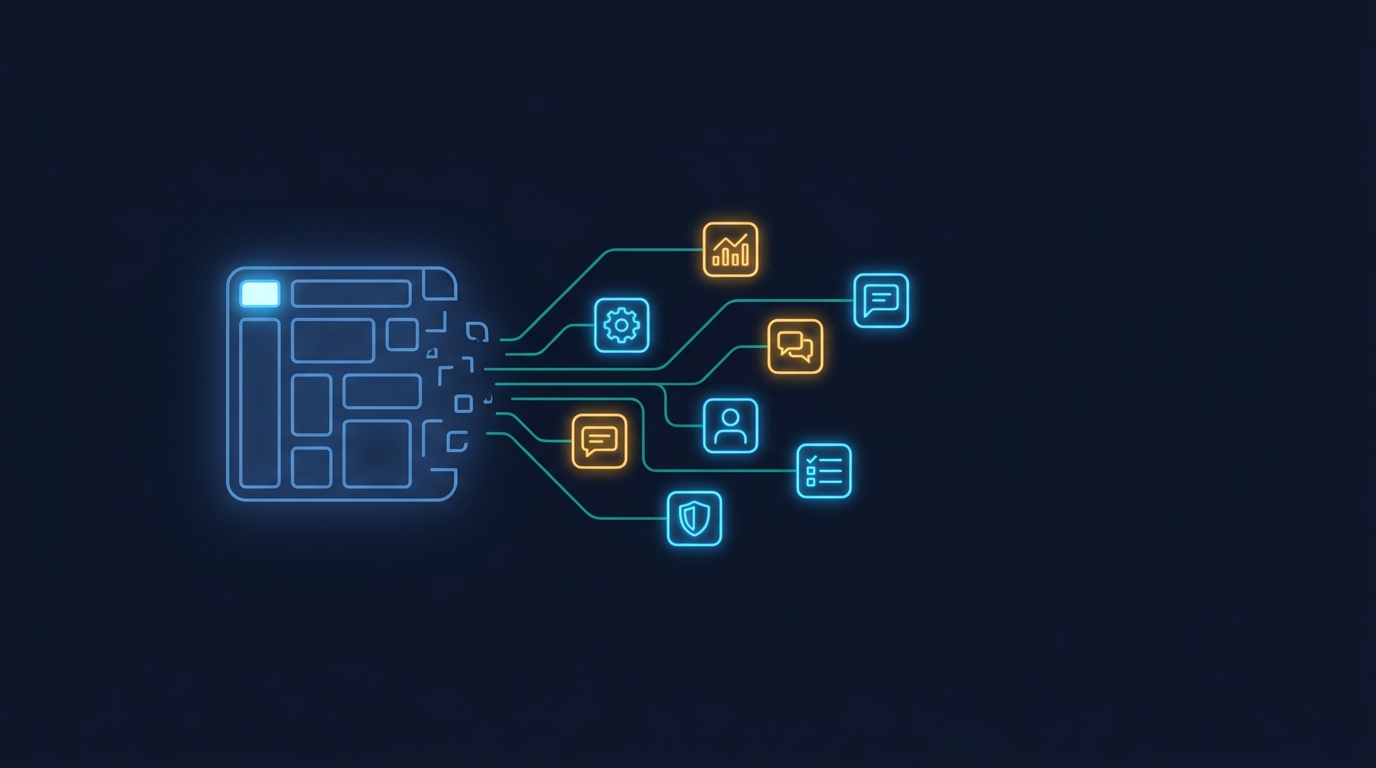
The solution isn't a better monolithic UI. It's the "Application-Driven Model." Instead of one big product, you provide a customization layer that sits on top of your existing APIs. This layer generates focused, single-purpose applications: microapps.
A microapp doesn't try to be your whole platform. It solves one workflow problem well. For example, instead of a "Leads Module," you give the sales rep a "Morning Lead Prioritizer" app. It ranks leads by urgency and provides one-tap follow-up actions. It's fast, it's relevant, and it inherits your platform's existing security model.
In a recent production deployment, we moved a B2B SaaS platform from a monolithic configuration approach to an AI-generated microapp marketplace. The shift was immediate. By allowing CS teams to "vibe code" specific apps for customers during onboarding, the time-to-value dropped from weeks to hours.
The Results of the Microapp Approach #
When you stop forcing users to bend their work around your software and start bending your software around their work, adoption sky-votes. Our first-party data from a Series B deployment shows that this modular approach reached a 90.8% adoption rate, with users opening at least one custom microapp regularly.
More importantly, the same data showed an 89% day-30 retention rate. Users keep coming back to tools that actually fit their specific operational needs. When the software becomes an invisible part of the workflow rather than a hurdle to overcome, the usage gap disappears.
What This Means for Your Product Roadmap #
Closing the usage gap requires a change in how you think about your product roadmap. Stop trying to build the "perfect" feature for everyone. Instead, focus on building a robust platform with strong APIs and a secure data model.
Then, layer on a customization engine that allows your Customer Success team—or even the customers themselves—to ship the last 20% of the solution. This allows your engineering team to stay focused on the core infrastructure while the AI handles the per-persona, per-workflow customization that actually drives retention.
Stop Losing Customers to the Usage Gap
Learn how to turn your SaaS into a platform with an embedded AI app marketplace.
Sources #
Footnotes #
-
Gainsight. "State of Customer Success 2025." https://www.gainsight.com/resource/state-of-customer-success-2025/ 2025. ↩
-
Forrester Research. "The Enterprise Software Adoption Report 2025." https://www.forrester.com/report/enterprise-software-adoption/ 2025. ↩
-
SaaStr. "2026 SaaS Product Roadmap Benchmarks." https://www.saastr.com/2026-benchmarks/ 2026. ↩