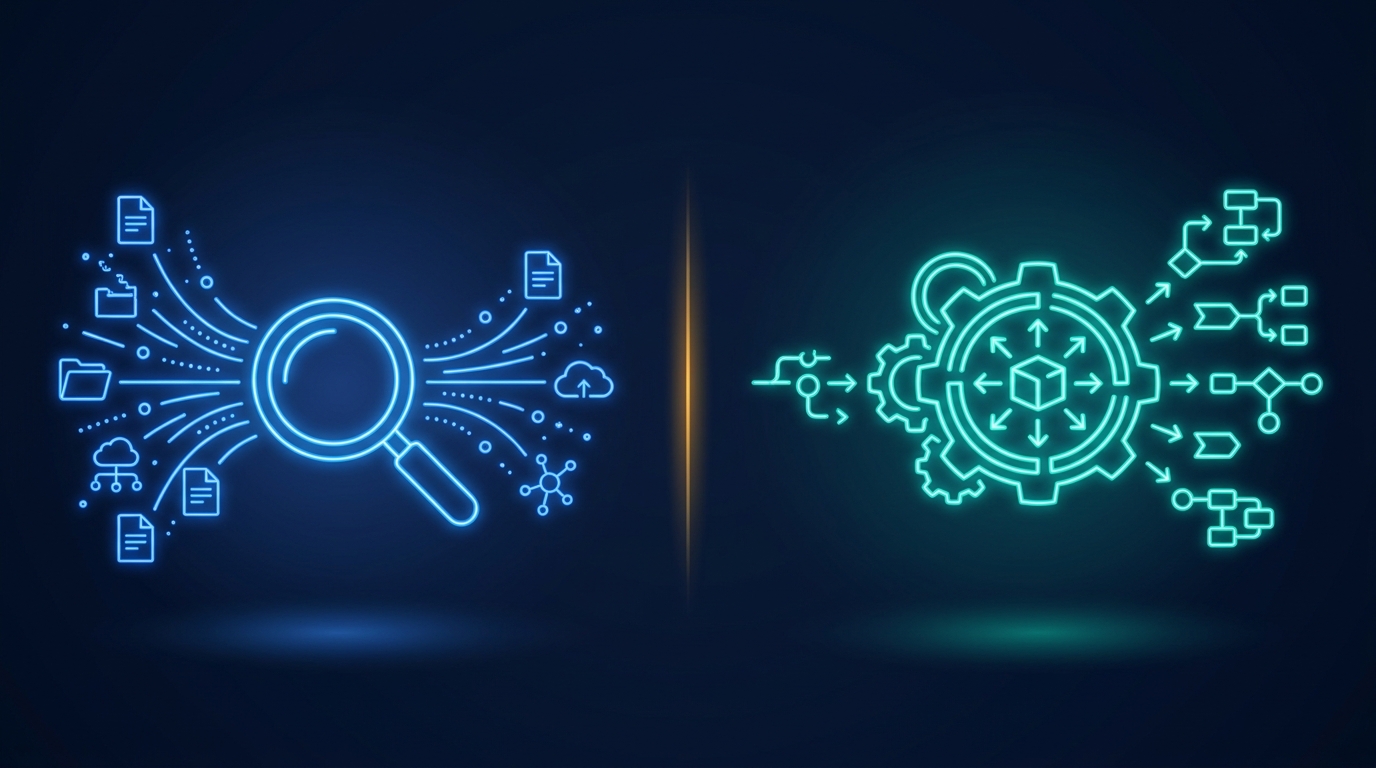
Glean and Gigacatalyst both get categorized as "enterprise AI," but they operate at completely different layers. Glean is an AI-powered enterprise search platform: it connects to your company's internal tools (Slack, Google Drive, Confluence, Salesforce, Jira) and lets employees find information across all of them using natural language. Gigacatalyst is a white-label AI app builder: it embeds inside B2B SaaS products so end-customers can build custom workflow applications using natural language.
If you're a SaaS founder hearing about both, the distinction matters: Glean is a tool your company buys for your employees. Gigacatalyst is a tool you embed inside your product for your customers. They don't compete. They serve different people solving different problems.
Key Takeaways
- Glean is enterprise AI search across internal tools; Gigacatalyst is an embedded AI app builder for SaaS customers
- Glean's buyer is the enterprise IT team; Gigacatalyst's buyer is the B2B SaaS company
- Glean helps employees find information; Gigacatalyst helps end-customers build workflow tools
- 67% of SaaS churn correlates with low adoption, a workflow problem, not an information problem (Gainsight, 2024)1
- Both are enterprise AI. They serve different layers: knowledge retrieval vs. workflow execution.
How Does Glean Work and What Is It Best For? #
Glean connects to an organization's internal tools, indexes their content, and provides a single AI-powered search interface across all of them. An employee can ask "what was the decision about the Q3 pricing change?" and Glean searches across Slack messages, Google Docs, Confluence pages, and email to synthesize an answer with citations to the original sources.
Glean raised at a $4.6 billion valuation in 2024, making it one of the highest-valued enterprise AI startups.2 Its value proposition targets a real problem: enterprise knowledge is scattered across dozens of tools, and employees spend significant time searching for information that exists somewhere but is hard to find.
For SaaS companies, Glean is useful as an internal productivity tool. Your support team uses it to find answers across your knowledge base. Your product team uses it to search across customer feedback from multiple channels. Your sales team uses it to find competitive intelligence from past deals.
Where Glean doesn't reach: your customers' operational workflows. A maintenance technician at one of your customer's companies doesn't need to search across Slack and Confluence. They need a tool that shows them which work orders to prioritize this morning, calculates parts costs for a repair, or generates a safety compliance report. That's not a search problem — it's a workflow fit problem.
How Does Gigacatalyst Work and What Is It Best For? #
Gigacatalyst embeds inside B2B SaaS products as a white-label AI app builder. It connects to the host platform's APIs, data model, and security rules. End-customers describe workflows in plain English, and the AI generates production-ready microapps that connect to their real operational data.
In a first-party deployment across 946 users, customers built 670+ custom workflow apps. 90.8% of users adopted at least one. 89% were still active 30 days later.3 These weren't enterprise employees searching for information. They were field workers, operations managers, and safety coordinators building tools that matched how their specific team does their specific job.
Where Gigacatalyst fits: the per-customer workflow gap inside B2B SaaS products. Every customer needs the product to work slightly differently, and engineering can't build custom features for each one.
Quick Comparison: Glean vs Gigacatalyst #
| Dimension | Glean | Gigacatalyst |
|---|---|---|
| What it does | AI-powered search across enterprise tools | AI-powered app builder inside SaaS products |
| Who buys it | Enterprise IT / CIO | B2B SaaS companies (embed for their customers) |
| Who uses it | Enterprise employees (all departments) | End-customers of SaaS products (operations, field teams) |
| Input | Questions about company knowledge | Workflow descriptions for custom apps |
| Output | Answers with cited sources from internal tools | Deployed workflow apps with live customer data |
| Data source | Slack, Google Drive, Confluence, Salesforce, etc. | Host SaaS platform's APIs and customer data |
| Deployment | Standalone enterprise tool | White-label, embedded inside SaaS product |
| Security | Enterprise SSO, role-based access to indexed content | Inherits host platform's security model (RBAC, row-level) |
| Pricing model | Per-employee seat license | Platform license to SaaS vendor |
Head-to-Head: Who Is the Buyer? #
Glean's buyer is the enterprise CIO or IT leader. The purchase decision involves evaluating Glean alongside other enterprise search tools (Coveo, Elastic, Microsoft Search). The procurement process includes security review, SSO integration, and per-seat pricing negotiation. Budget comes from the IT or productivity tools budget.
Gigacatalyst's buyer is the B2B SaaS company. The purchase decision involves evaluating Gigacatalyst alongside other approaches to customer customization (building in-house, buying Retool, adding configuration options). The evaluation is led by the VP of Product or VP of Customer Success. Budget comes from the product or customer retention budget.
These are different buyers in different departments evaluating different categories of software for different purposes. A SaaS company might buy Glean for their own employees while simultaneously embedding Gigacatalyst for their customers.
Head-to-Head: What Problem Does Each Solve? #
Glean solves the enterprise knowledge fragmentation problem. Information exists across too many tools. Employees waste time searching. Institutional knowledge is hard to access. The value is in reducing time spent looking for information and increasing the quality of decisions by surfacing relevant context.
Gigacatalyst solves the SaaS workflow mismatch problem. B2B SaaS products serve customers with fundamentally different operational workflows. The product can't match all of them with one interface. Customers who don't find workflow fit adopt less, use workarounds, and eventually churn. 67% of SaaS churn correlates with this adoption gap.1
The problems are related but distinct. An enterprise employee who can't find information has a knowledge access problem. A SaaS customer whose product doesn't match their workflow has a product fit problem. Different problems, different tools.
Head-to-Head: What Gets Produced? #
Glean produces answers: synthesized text with cited sources from across the organization's toolset. The output is ephemeral. You ask a question, you get an answer, you act on it. The value is in the retrieval and synthesis, not in a persistent artifact.
Gigacatalyst produces applications: versioned, deployed, governed microapps that persist inside the SaaS platform. A morning job prioritization dashboard that a roofing crew opens every day. An inspection workflow that a hospital facilities team runs every shift. A maintenance scheduler that a fleet operator uses for every vehicle rotation.
The outputs serve different purposes in different contexts. Glean's answers inform decisions. Gigacatalyst's apps shape daily workflows.
When Should a SaaS Company Consider Glean? #
Consider Glean (or similar enterprise search) for your own company when:
- Your team spends significant time searching for information across multiple internal tools
- Institutional knowledge is siloed in individual employees' heads or inboxes
- Your support team needs to search across your knowledge base, customer conversations, and product documentation to answer tickets
- Your company has 200+ employees and information fragmentation is a measurable productivity problem
Glean is an internal tool. It helps your team work more efficiently. It doesn't directly affect your customers' experience with your product.
When Should a SaaS Company Consider Gigacatalyst? #
Consider Gigacatalyst for your product when:
- Your customers have diverse operational workflows that one product interface can't serve
- Your feature request backlog is full of "make this work slightly differently for our team" requests
- Your CS team spends significant time on workarounds rather than driving adoption
- Churn correlates with low adoption in specific customer segments
- You need per-customer customization at scale without consuming engineering bandwidth
Gigacatalyst is a customer-facing platform layer. It directly affects your customers' experience, adoption, and retention.
Can You Use Both? #
Absolutely, and it's a natural combination for B2B SaaS companies at scale.
Glean helps your internal team find information faster: customer context for support tickets, competitive intelligence for sales, product feedback for the roadmap team. This makes your team more effective at serving customers.
Gigacatalyst helps your customers build workflow-specific tools inside your product. This makes the product fit each customer's operations better, driving adoption and retention.
Your team uses Glean to understand customers better. Your customers use Gigacatalyst to make the product work the way they need it to. The tools complement at different layers of the value chain.
See Gigacatalyst in Action
Gigacatalyst is the white-label AI app builder B2B SaaS companies embed for per-customer workflow customization. Your employees use Glean to find answers. Your customers use Catalyst to build workflows.
Frequently Asked Questions #
Is Glean a competitor to Gigacatalyst?
No. They serve different buyers, different users, and different problems. Glean is an enterprise productivity tool purchased by IT departments for internal employees. Gigacatalyst is a product infrastructure layer purchased by SaaS companies for their customers. A B2B SaaS company could use both without any overlap in functionality or budget.
Can Glean be embedded in a SaaS product the way Gigacatalyst is?
Glean offers some embeddable features (search widgets, knowledge assistants), but its primary design is enterprise-wide search across internal tools. Gigacatalyst is purpose-built for white-label embedding: it reads the host platform's APIs, inherits the security model, and generates apps within the platform's UI. The architectural foundations are different because the use cases are different.
Which has better ROI for reducing SaaS churn?
Gigacatalyst addresses churn directly. 67% of SaaS churn correlates with low adoption from workflow mismatch.1 Gigacatalyst closes that gap with per-customer workflow apps that hit 90.8% adoption in production.3 Glean reduces churn indirectly by making your CS and support teams more efficient at helping customers. Both contribute to retention, but through different mechanisms.