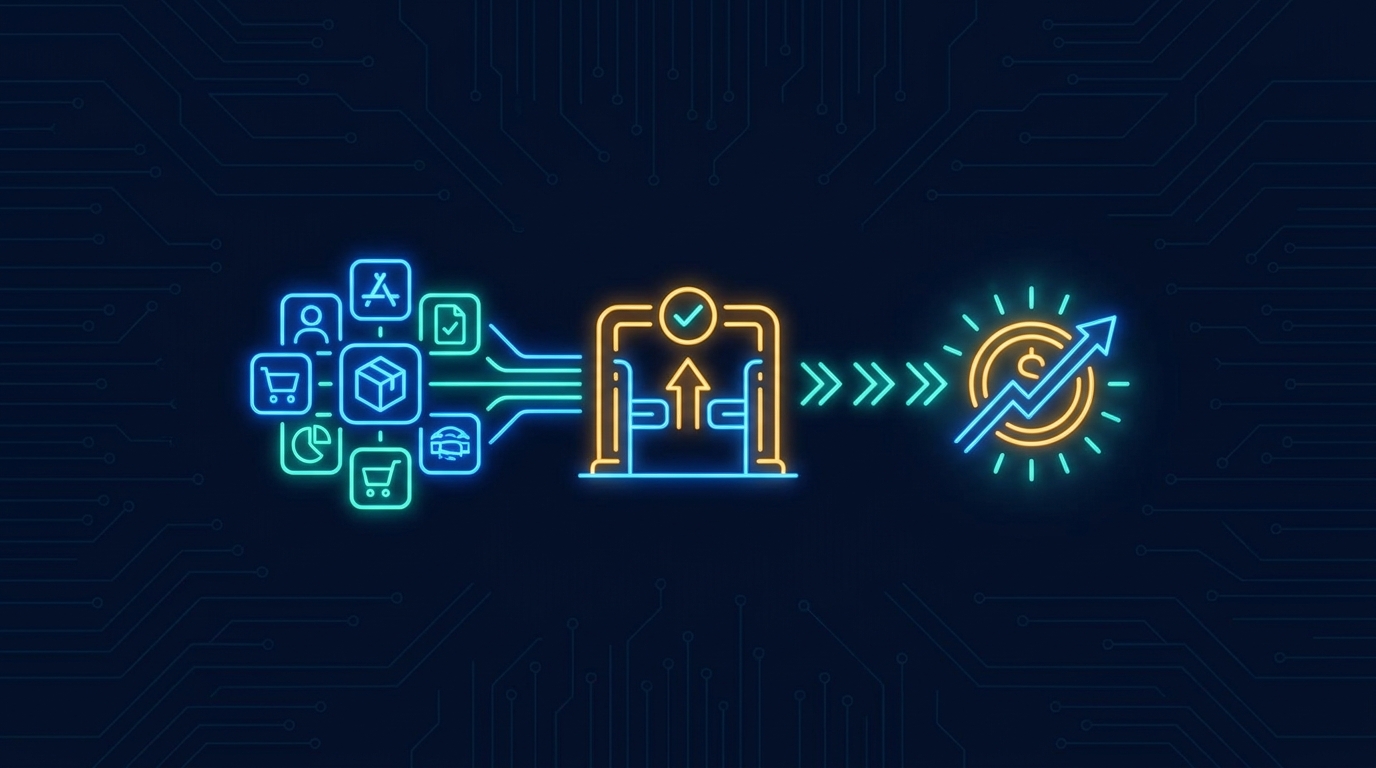
A SaaS app marketplace needs review gates before it needs revenue sharing.
That came up on a call with a lab software founder. He liked the idea of customers building apps inside the product, then asked the marketplace question almost immediately: if one customer builds something great and other customers use it, should the builder get paid?
It is the right question. But it is not the first one. Before a customer-built app becomes a marketplace asset, the SaaS company has to decide what gets reviewed, who supports it, and how it behaves inside the product boundary.
Key Takeaways
- A B2B app marketplace lets developers or partners publish apps that extend a core product, according to Partner Fleet.1
- Customer-built apps make the marketplace more interesting because the supply comes from real workflows, not only vendor-planned integrations.
- Review gates should come before revenue sharing: permissions, data access, quality, support ownership, and repeat usage need to be clear first.
What is different about a customer-built SaaS app marketplace? #
A customer-built SaaS app marketplace is different because the apps come from actual customer workflows inside the product.
Most app marketplaces start with partners and integrations. A vendor lists the tools that connect to its product. Customers install what they need. That model works, and buyers already understand it. Partner Fleet defines an app marketplace as a hub where developers publish integrations and apps that extend the core product.1
Customer-built apps change the supply side. A user creates a workflow because their company needs it today: a lab review queue, a mobile inspection checklist, a customer-specific dashboard, a field intake form. If the app works, another team may want it too.
That is more powerful than a normal request board. The customer did not just ask for a feature. They built the first version.
Why does review matter before monetization? #
Review matters before monetization because a marketplace app represents the host product, even when a customer built it.
The founder on the call saw this quickly. He asked whether a customer that made a useful app should get a share of revenue if other companies installed it. Then he added the obvious concern: his company would still want to ensure quality.
That is the right order. Revenue sharing makes the app feel like a product. Once money changes hands, someone expects support, reliability, billing rules, documentation, and a clear answer when it breaks. If the SaaS company skips review, the marketplace can turn into a pile of customer experiments that look official but behave unevenly.
A customer-built app should earn distribution before it earns monetization.
What should the review gate check? #
The review gate should check five things: permissions, data access, app behavior, support ownership, and usage evidence.
Permissions come first. The app should inherit the same login, role rules, tenant isolation, and audit trails as the host SaaS product. A customer who cannot see a record in the core product should not see it through a marketplace app.
Data access is next. The app should only call approved APIs, and it should be clear whether it creates new data, edits existing records, or only reads from the product. This matters because some customer apps are harmless dashboards, while others change operational records.
Then comes product behavior. Does the app use approved components? Does it work on the screens or devices where users will run it? Does it fail clearly? Does it have a version history so customers can roll back?
Support ownership has to be explicit. If the original builder leaves the customer company, does the app keep working? If another customer installs it, who answers the ticket?
Usage evidence should be the last check before promotion. One impressive demo is not enough. The stronger signal is repeat usage inside the original account, or several accounts building similar versions independently.
When should a customer app enter the marketplace? #
A customer app should enter the marketplace when it solves a repeated workflow and can be supported without becoming a hidden services project.
A strange internal workflow may be perfect for one customer and wrong for everyone else. Keep it private. A workflow that appears across several accounts deserves a different path. It can become a first-party template, a reviewed community app, or eventually a core feature.
The marketplace should not be a dumping ground for every generated app. It should be the curated layer above private customization. That keeps the app store useful and protects the core product from absorbing every edge case too early.
This is where customer-built apps give product teams a useful signal. If ten customers build similar inspection apps, the product team can decide whether to publish a reviewed template. If one customer builds a niche birthday-triggered lab workflow, it can stay local.
How does revenue sharing fit later? #
Revenue sharing fits after the SaaS company knows which apps are safe, useful, and supportable.
Microsoft Marketplace separates listing and transaction choices for SaaS offers, and a transactable listing means Microsoft handles the exchange of money for the license on the publisher's behalf.2 That is a heavier commitment than a directory entry. It changes billing, support, and customer expectations.
Inside a SaaS product, the same principle applies at a smaller scale. A customer-built app can move through stages:
- private app for one customer
- shared app inside one company
- reviewed template for other customers
- monetized marketplace app, if support and billing make sense
Most apps should never reach the last stage. That is fine. The marketplace still works if it helps customers find useful workflows faster. Revenue sharing is an incentive system for the exceptional apps, not the default reason the marketplace exists.
What does this change for SaaS product teams? #
It turns app marketplace strategy into product governance, not just ecosystem marketing.
Traditional marketplaces often prove that a SaaS product connects to the rest of the customer's stack. Customer-built app marketplaces can prove something different: the product is adaptable without turning every customer request into a roadmap item.
That only works if the vendor keeps the boundary clear. Customers can build. Product can observe. The marketplace can curate. The core product only absorbs the patterns that usage proves are broad enough.
Gigacatalyst is built around that boundary. Customers can create apps inside the SaaS product, using the host product's APIs, permissions, and design system. The marketplace layer then decides which apps stay private, which become templates, and which are worth wider distribution.
Want a safer app marketplace inside your SaaS?
Gigacatalyst lets customers build governed apps inside your product, then gives your team the review layer to decide what should spread.
FAQ #
Conclusion #
The exciting version of a SaaS app marketplace is not a giant catalog.
It is a path from private workflow to reviewed shared app. Customers build what they need. Product sees what keeps getting used. The marketplace spreads the useful patterns without forcing every edge case into the core product.
That is why review gates matter. They keep customer creativity from turning into product chaos.
Sources #
Footnotes #
-
Partner Fleet. "What is an app marketplace and when do you need one for your SaaS product?" https://www.partnerfleet.io/blog/what-is-an-app-marketplace 2026. ↩ ↩2
-
Microsoft Learn. "Plan a SaaS offer for Microsoft Marketplace." https://learn.microsoft.com/en-us/partner-center/marketplace-offers/plan-saas-offer 2026. ↩